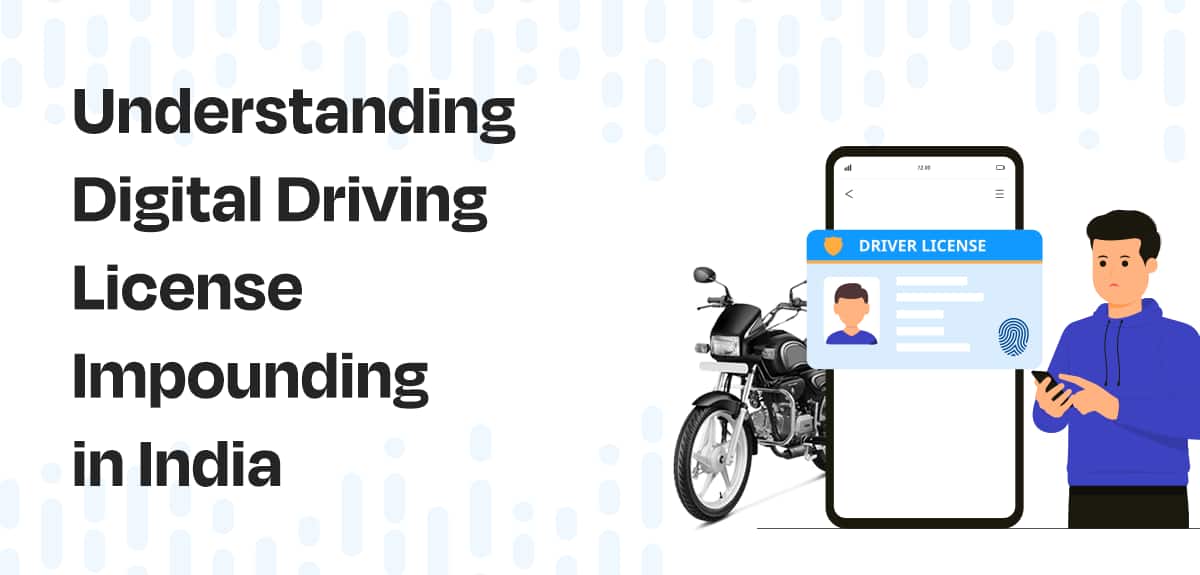
Understanding Digital Driving License Impounding in India
- Home

- Motor Insurance
- Bike Insurance
- Articles - TWI
- Understanding Digital Driving License Impounding in India
In India, driving license impounding refers to when authorities suspend or invalidate a driver's license due to serious traffic violations or legal offenses. This happens when a traffic violation is recorded, and instead of physically seizing the driving license. This article explains how it works, the offenses that can lead to impounding, and how evidence is gathered.
How Does It Work?
Instead of physically seizing a license, traffic authorities now often mark it as impounded in an online database. This is done through the VAHAN/SARATHI database, accessible via the mParivahan app and DigiLocker.
The process generally involves these steps:
Step 1: Traffic Violation: When the driver commits any traffic offence, the traffic police issues an eChallan.
Step 2: Digital Impounding: Instead of asking for the physical driving license, the traffic authority marks their DL as impounded in the VAHAN/SARATHI database through the eChallan system.
Step 3: mParivahan & DigiLocker: The impounded DL status is also reflected in the driver's records on the mParivahan app & DigiLocker. Both are the government platforms for digital driver licenses and other related documents.
Step 4: Paying the Fine: Once the driver pays the fine for the offence or fulfills other requirements, the impounded status is lifted from the traffic authority database.
Which Traffic Offenses Lead to Digital Impounding of Driving Licenses?
Depending on the offence's severity and the specific region's laws, the impounding can be temporary (for a specific period) or permanent (requiring you to reapply for a license after a certain period).
Here is a list of common reasons mentioned due to which the driving licenses are impounded digitally:
- Driving under the influence of alcohol or drugs
- Reckless driving or speeding
- Causing an accident with serious injuries or fatalities
- Accumulating too many traffic violations
- Driving without a valid license or active bike insurance policy
- Using a fake or tampered license
How Can Police Gather Evidence for Digitally Impounding a DL of a Bike Rider?
The police can gather evidence for digitally impounding the driving license of a bike rider through various means. Here are some common methods:
-
Direct Observation
- Traffic police presence: Traffic police officers directly observing a bike rider committing a traffic violation is the most common way. This includes:
- Riding without a helmet
- Violating traffic signals (e.g., jumping a red light)
- Overtaking dangerously
- Riding on the wrong side of the road
- Speeding
- Riding under the influence of alcohol or drugs
- Visual recording: They also may use body cameras or dashboard cameras in patrol vehicles to record the violation as it happens.
- Traffic police presence: Traffic police officers directly observing a bike rider committing a traffic violation is the most common way. This includes:
-
Technological Evidence
- CCTV footage: Traffic cameras and CCTV systems installed in many cities can capture traffic violations. This footage can be used as evidence to identify the bike rider and the offence.
- Speed cameras: Speed cameras capture images of vehicles exceeding the determined speed limit, along with the vehicle's registration number and the speed at which it travels.
- Red light cameras: These cameras are triggered when a vehicle crosses the stop line after the traffic light turns red, capturing photographic evidence of the violation.
-
Documentation
- eChallan: When a traffic violation is detected, the police can issue an eChallan, a digital record of the offence. This challan includes details of the violation, the bike rider's information (if available), and the applicable fine.
- Photographs: Police officers may take pictures of the traffic violation or the bike rider's documents as evidence.
-
Breathalyzer Tests
DUI cases: If the police suspect a bike rider of driving under the influence of alcohol, they can conduct a breathalyzer test to measure the rider's blood alcohol content.
Once the evidence is gathered, the police can digitally impound the driving license in the central database through the eChallan system. This information is reflected in the rider's records on the mParivahan app and DigiLocker.
It's important to remember that the specific methods and procedures for gathering evidence and digitally impounding a driving license may vary slightly depending on the state and local traffic laws. Hence, you must check it with your respective traffic authorities to get the correct information.
Final Words!
Digital driving license impounding in India smoothens and enhances traffic enforcement through technology. By leveraging digital databases and various evidence-gathering methods, authorities can efficiently manage moving traffic and promote road safety. This system, using platforms like VAHAN/SARATHI, mParivahan, and DigiLocker, simplifies enforcement and aims to improve road safety. However, it is always advisable to consult local traffic authorities for specific regulations in your region.