Processing


Roads facilitate the movement of millions of citizens in India. The road network in India is the second largest in the world, spanning over 6 million kilometres. But this expansive connectivity poses a critical challenge to road safety in the country. According to recent reports from the Ministry of Road Transport and Highways (MoRTH), India witnesses lakhs of road accidents annually. It becomes essential to ensure safe driving on highways & ghats in such a scenario. Read on to know how you can safely navigate Indian roads.
Ensuring road safety requires a combination of technical skill, environmental awareness, and psychological discipline. Check the following top ten tips to help minimise risk and enhance your driving experience:
Speeding is the leading cause of road fatalities in India. Adjust your speed to the posted speed limit and road conditions. Highways with high speed limits do not necessarily mandate driving faster. You should drive at a speed where you can easily navigate the car and apply the brakes in time if needed. Even a little increase in your speed can result in a major impact during a collision.
The right-most lane is reserved for overtaking on a multi-lane highway. You should safely return to the middle or left lane after you have passed a vehicle. Switching lanes constantly without giving proper indicators is a primary cause of high-speed accidents. Lane discipline allows traffic to flow predictably and reduces the need for unexpected braking.
It is a dangerous habit to tailgate on public roads in India. The human reaction time, combined with the mechanical time required for brakes to engage, requires a significant buffer to react to someone applying the brakes in front of you. The 3-second rule involves picking a stationary object (like a signpost) and ensuring that at least 3 seconds pass after the vehicle in front passes it before you do. You must double this gap during rain or on steep descents.
Your indicators are your primary means of communication with other drivers. Use them at least 100 feet before making a turn or changing lanes. The use of side-view mirrors is equally important for safety. You should check your vehicle's rearview mirrors every few seconds to maintain 360-degree situational awareness. Use high-beam headlights responsibly to ensure safe driving practices at night. Switch to low beam for oncoming traffic to avoid blinding the other driver.
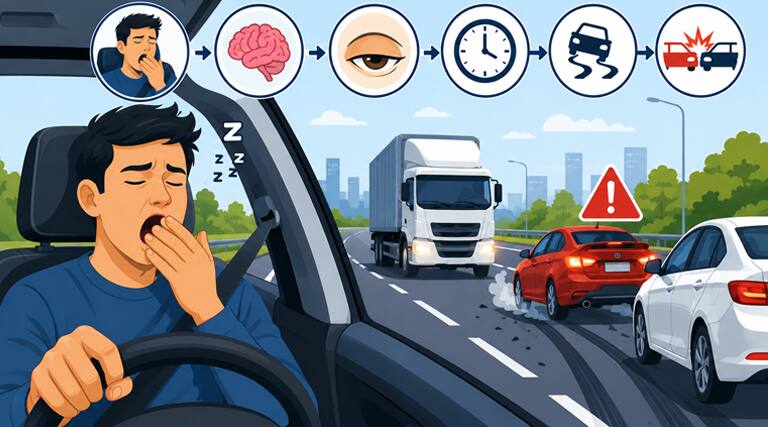
Long, straight expressways can result in a trance-like state known as highway hypnosis. In such a situation, driver fatigue impacts road safety and this is how you prevent this:
Driving in mountainous or ghat regions requires more caution than driving on highways. A basic rule is that vehicles going uphill have priority. If you are descending and encounter a vehicle climbing a narrow stretch, you should stop or reverse to give it way. Uphill vehicles need continuous momentum, and stopping them can overwork the engine and clutch, making restarting difficult and unsafe. Even though new cars come with hill assist features, it might still not be enough.
A split-second distraction can be fatal. Mobile phone usage, even with hands-free devices, diverts cognitive resources away from the road. Other distractions include adjusting the infotainment system, eating while driving, or having intense conversations with passengers. If you need to use the GPS, set the destination before you start the engine and use voice prompts to keep your eyes on the road.
It is a common misconception that seatbelts are only important for the driver and front passenger. In reality, seatbelts are essential for everyone in the vehicle, including those sitting in the rear seats. In a high-speed crash, unbelted rear-seat passengers become more prone to serious injuries. Wearing a seatbelt keeps passengers securely in place and reduces the impact of a crash.
Defensive driving is the practice of anticipating potential hazards before they happen. Do not assume other drivers will follow the rules. Watch for signs like a swaying truck might indicate that the driver is tired, a ball rolling into the street likely means a child is following it, etc. This helps you avoid unforeseen circumstances.
Due to extreme weather conditions in India, road safety becomes an issue. Extreme heat can result in tyre bursts, and torrential monsoons can lead to hydroplaning. Hydroplaning occurs when a layer of water builds up between the tyres and the road surface, which causes a loss of traction. If this happens, do not simply apply the brakes. Instead, ease off the accelerator and keep the steering wheel straight until you feel the tyres regain grip.
Maintaining your vehicle is not just about extending your car's life. It is also a critical component for road safety.
The tyres are the only point of contact between your vehicle and the road. Ensure they are inflated to the manufacturer's recommended PSI (usually found on the driver-side door jamb). Under-inflated tyres build up excessive heat on highways, leading to tyre bursts. Furthermore, check the tread depth regularly. For safe driving on highways & ghats, a minimum tread depth of 2mm to 3mm is recommended to ensure sufficient grip for cornering on mountain roads and to disperse water during rain.
In the ghats, your brakes undergo immense thermal stress. Constant braking on a descent can lead to brake failure. Ensure brake fluid is clean and at the correct level. You should use engine braking to control speed when going downhill to reduce the burden on your mechanical brakes.
Faulty tail lights or indicators are a major cause of rear-end collisions. It becomes especially concerning in foggy conditions or at night. Regularly check that all bulbs are functional. Keep your windshield wipers in top condition to drive safely during rain, as ineffective wipers during a heavy downpour can reduce visibility to near-zero.
A breakdown in the middle of a high-speed highway or a remote mountain pass is a significant safety hazard. Regularly check engine oil, coolant levels, and battery health. A well-maintained engine is less likely to stall or overheat when climbing steep inclines.
Some of the most important road safety rules include following speed limits, wearing seatbelts at all times, avoiding distractions like mobile phones, maintaining proper lane discipline, and staying alert with a defensive driving mindset. Taking regular breaks on long drives and keeping your vehicle well-maintained also play a key role in ensuring overall safety.
Brake fade occurs when the braking system overheats due to regular use. Use engine braking to avoid this. Shift your vehicle into a lower gear (2nd or 3rd) so the engine's internal resistance helps control the speed. You should use the same gear to go down a hill that you would use to climb it.
While high beams provide more light, they can also reduce the visibility for drivers coming from the opposite side. This blindness can lead to head-on collisions. Use high beams only on unlit roads when no other vehicles are in sight, and always switch to low beams as soon as you see oncoming vehicles.
No, driving in neutral mode is extremely risky due to the risk of brake failure because of overheating, ineffective power steering, and more.


The road scams that occur in India are probably more frequent than
Read more
To avoid costly repair bills and to ensure your car's optimal
Read more
The tyres of your car are one of its most critical components, as
Read more
Driving requires constant focus, precision, and quick
Read more
While fog in winter is common, it can be quite problematic for
Read moreInsurance
Calculators
Payment Methods


Secured With

Follow us on