

 We don't spam
 group health insurance" loading="lazy" width="100%" height="100%" />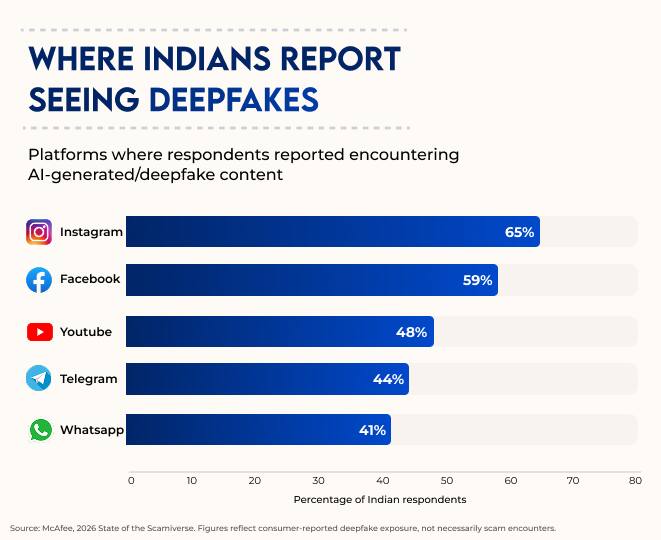





 Expert advice made easy


Download the Policybazaar app
to manage all your insurance needs.
Artificial intelligence is making digital content increasingly realistic. While this has useful applications, the same technology is being misused by cybercriminals to create fake voices, videos and images that canappear genuine. These deepfake scams can be used to impersonate family members, senior executives, public figures, financial experts or even trusted organisations to trick people into transferring money or sharing sensitive information.

A deepfake scam is a type of fraud in which criminals use artificial intelligence to create or manipulate videos, images or voice recordings to make someone appear to say or do something they never actually did.
For example, a fraudster could use publicly available videos and voice recordings of a company executive to create a fake video call. They may then instruct an employee to urgently transfer money to a particular account. Similarly, scammers may clone the voice of a family member and claim that they need money urgently.
Deepfake technology can be used to:
The problem is that modern deepfakes can be difficult to distinguish from genuine content. Many reports also highlight that deepfakes can be used to impersonate people and steal money or data.
Most deepfake scams follow a relatively simple sequence:
This combination of AI-generated content along with the impersonation and urgency makes deepfake scams particularly dangerous.
Deepfake fraud can take several forms depending on how the fake content is used.
Fraudsters use AI-generated video to impersonate a trusted person during a video call. For example, a scammer may pretend to be a senior executive and instruct an employee to make an urgent payment.
The scammer uses AI to replicate someone's voice and then makes a phone call requesting money or sensitive information. A familiar voice should therefore not automatically be treated as proof of identity.
AI-generated photographs or videos can be used to create fake identities or bypass certain verification processes.
Fraudsters may create videos featuring celebrities, financial experts or public figures promoting fake investments, trading opportunities or other financial schemes.
A scammer may clone the voice or appearance of a family member and claim to be facing an emergency. The objective is usually to make the victim act before they have time to verify the request.
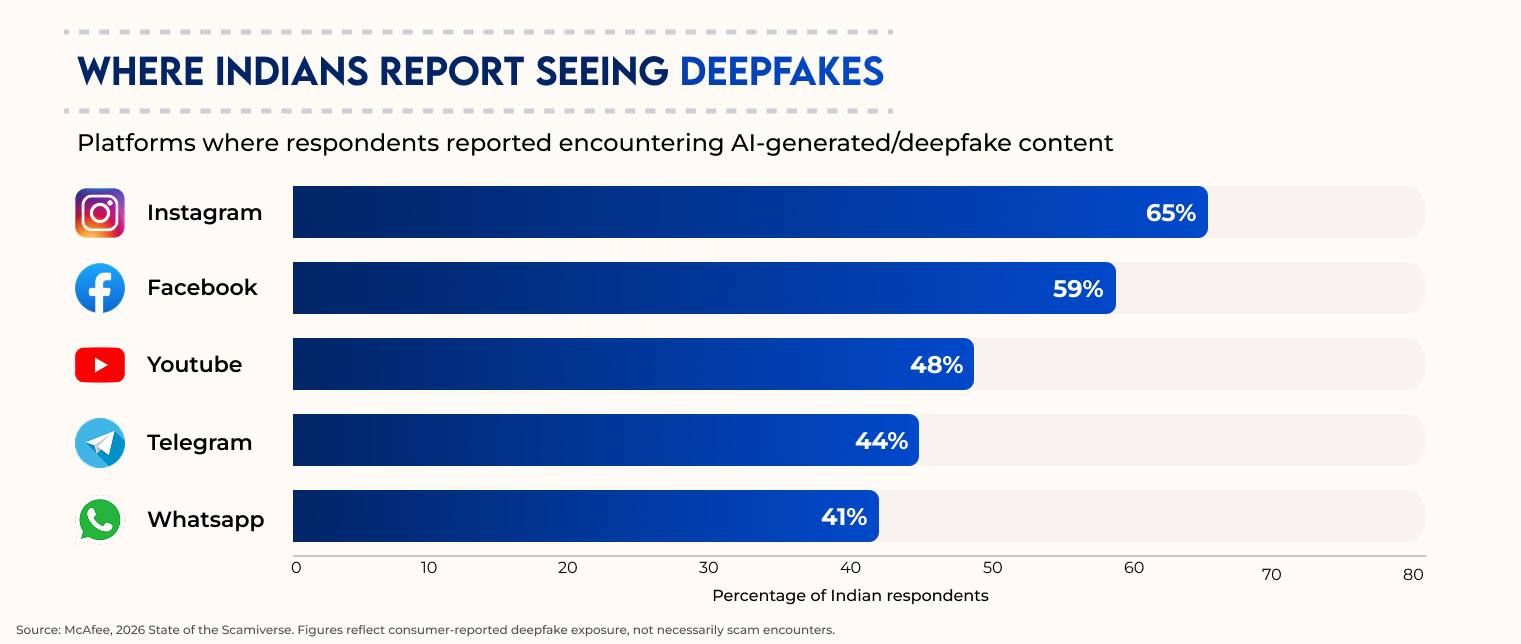
Deepfake scams are part of a much larger digital fraud problem in India. McAfee's 2026 State of the Scamiverse report found that:
What does this tell us? Deepfake fraud should not be viewed as an isolated technology problem. It is becoming another tool within the broader ecosystem of online scams, social engineering and financial fraud.
In early 2024, an employee at global engineering company Arup was reportedly tricked into transferring approximately US$25.6 million after fraudsters used deepfake technology to impersonate the company's CFO and other executives during a video conference.
In 2024, a clerk at a multinational company in Hong Kong was reportedly deceived into transferring HK$200 million after participating in a video conference where fraudsters impersonated senior executives using deepfake technology.
In 2019, a UK-based energy company CEO received a call from someone who sounded like the CEO of the company's German parent company. The caller requested an urgent transfer of €220,000 to a supplier. The voice was later identified as part of a deepfake scam.
In 2025, a finance director at a multinational company in Singapore reportedly authorised a US$499,000 payment after joining a Zoom call with individuals he believed were senior executives. The meeting was allegedly created using AI-generated visuals and voices.
The above incidents demonstrate an important lesson: seeing and hearing someone is no longer sufficient proof of identity.
If someone asks for money or sensitive information, contact them separately using a known phone number or another trusted communication channel.
Pause before acting on an unexpected request. A legitimate emergency does not necessarily mean you should skip verification.
The more photographs, videos and voice recordings publicly available about you, the more material scammers may have to work with. Review your social media privacy settings regularly.
Enable MFA on banking, email and other important accounts to add another layer of protection.
Never share passwords, PINs, OTPs or banking credentials merely because the person on the other end appears familiar.
If you believe you have fallen for a deepfake scam, act quickly.
Pro Tip: Don't delete suspicious messages or call records. They may help establish what happened during the investigation.
Deepfake scams can result in consequences such as theft of funds, identity theft, online financial fraud and other cyber-related losses. Personal Cyber Insurance available through Policybazaar is designed to protect individuals against financial losses arising from cyber threats, including identity theft and online fraud.
However, it is important to understand that not every deepfake-related loss will automatically be covered.
Coverage depends on the specific policy wording, insured event, applicable conditions, exclusions and limits.
Depending on the policy, personal cyber insurance may provide protection for risks such as:
So, if a deepfake is used as part of a covered cyber fraud, Cyber Retail Insurance may help mitigate the financial impact, subject to the terms of the chosen policy.
Important: Cyber insurance is not a replacement for verification and cybersecurity precautions. Always check whether deepfake-enabled fraud, unauthorised transactions or the specific type of financial loss is covered before purchasing a policy.
| Factor | Traditional Online Scam | Deepfake Scam |
| Main technique | Fake links, messages or websites | AI-generated voice, video or images |
| Impersonation | Usually text or basic caller impersonation | Can replicate a person's appearance or voice |
| Trust factor | Depends on convincing messages | Uses realistic digital identity |
| Common objective | Steal money or credentials | Steal money, information or impersonate someone |
| Detection | Often easier through links or spelling errors | Can be significantly harder to identify |
The important difference is how convincingly the scammer can imitate a trusted person.
Conclusion
Deepfake scams are changing the way online fraud works. A scammer no longer needs to rely only on a convincing message or phone call; they can potentially recreate a person's face, voice and mannerisms to make a fraudulent request appear genuine.
As AI-generated content becomes more sophisticated, the safest approach is to verify before trusting. Don't transfer money simply because a familiar face appears on a video call or a familiar voice is heard on the phone.


Insurance
Calculators
Payment Methods


Secured With

Follow us on


