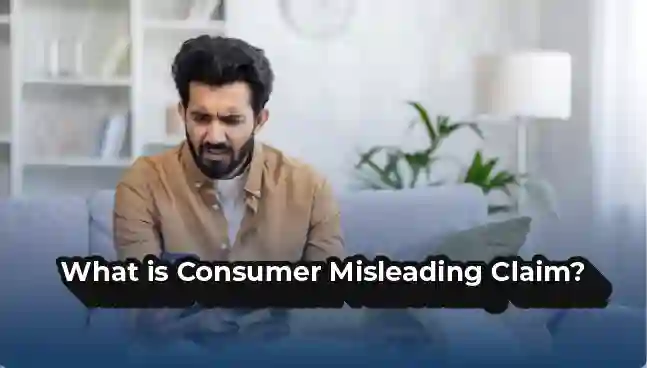
What is a Consumer Misleading Claim?

In today’s competitive marketplace, advertising plays a powerful role in influencing consumer decisions. However, when businesses exaggerate benefits, hide material information, or present false promises, those representations may amount to a consumer misleading claim. Understanding what constitutes a misleading claim is crucial for businesses, advertisers, compliance teams, and consumers alike. In India, misleading claims are regulated under statutory and self-regulatory frameworks to ensure transparency and fair trade practices. This article explains what a consumer misleading claim is, its legal basis, examples, consequences, and how businesses can avoid regulatory risk.

Read more
₹1 Crore cover starting at ₹4,720/year+
Safeguard your business against
claims of bodily injury
We don't spam
View plans
By clicking on "View plans" you agree to receive assistance and agree to our Privacy Policy and Terms Of Use
Continue Journey
By clicking on "Continue Journey" you agree to receive assistance and agree to our Privacy Policy & Terms Of Use
  • Wallet-friendly plans
  • 24/7 claim support
  • IRDAI-certified advisors

We don't spam

We don't spam


Meaning of a Consumer Misleading Claim

A consumer misleading claim refers to any representation, whether in advertising, packaging, labelling, or marketing communication, that:

  • Is false or factually incorrect
  • Exaggerates or distorts product benefits
  • Omits important information
  • Creates a false impression about quality, price, origin, or performance
  • Deceives or is likely to deceive consumers

Importantly, the claim does not have to be intentionally fraudulent. Even statements that are technically true but presented in a way that misleads the average consumer may qualify as misleading.

Legal Framework in India

1. Consumer Protection Act, 2019

The primary legislation governing misleading claims is the Consumer Protection Act, 2019.


Under this Act:

  • “Misleading advertisement” includes any advertisement that falsely describes a product or service.
  • It also covers advertisements that provide false guarantees or conceal important information.
  • Endorsers (including celebrities) can be held liable for misleading endorsements.

The Act empowers authorities to penalise manufacturers, service providers, advertisers, and endorsers.


2. Central Consumer Protection Authority (CCPA)

The Central Consumer Protection Authority (CCPA) is empowered to:

  • Investigate misleading advertisements
  • Order discontinuation or modification of ads
  • Impose penalties on manufacturers and endorsers
  • Prohibit endorsers from making future endorsements

The CCPA has actively taken action in cases involving exaggerated health claims, false “100% safe” claims, and deceptive pricing tactics.


3. Advertising Standards Council of India (ASCI)

The Advertising Standards Council of India (ASCI) is a self-regulatory organisation that monitors advertising content.


ASCI guidelines require that advertisements:

  • Be truthful and honest
  • Not exaggerate claims
  • Not misled by ambiguity or omission
  • Substantiate claims with evidence

Although ASCI is not a statutory authority, many businesses voluntarily comply with its code to avoid reputational and regulatory consequences.

Types of Consumer Misleading Claims

Misleading claims can take many forms. Some common categories include:


1. False Performance Claims

Example: Claiming a product “removes 99.9% bacteria” without scientific testing to substantiate it. If such data is unavailable or unverified, the claim may be considered deceptive.


2. Exaggerated Health or Safety Claims

Products marketed as “completely safe,” “zero side effects,” or “clinically proven” without evidence can mislead consumers, especially in the pharmaceuticals, cosmetics, or food industries.


3. Hidden Conditions

Example: Advertising “Buy One Get One Free” while hiding conditions in fine print.


If key limitations are not prominently disclosed, the overall message may mislead consumers.


4. Comparative Misrepresentation

Claims like “India’s No. 1 brand” or “Better than all competitors” require verifiable data. Without substantiation, such claims may violate consumer protection standards.


5. Pricing Deception

Artificially inflating the original price and then advertising a heavy discount can create a false perception of value.


6. Endorsement-Based Misleading Claims

If a celebrity endorses a product claiming personal usage without due diligence, and the product fails to meet advertised standards, liability may arise.

What Makes a Claim “Misleading”?

Courts and regulators often evaluate misleading claims using the “average consumer test.”


The question is:
Would an average, reasonable consumer be misled by the representation?


The focus is on the overall impression created by the advertisement, not just isolated words.


The Supreme Court of India has emphasised consumer welfare and transparency in various judgments, reinforcing that advertising must not exploit consumer trust.

Consequences of Making a Misleading Claim

Businesses found guilty of misleading claims may face:

  • Monetary penalties
  • Product recall orders
  • Discontinuation of advertisement
  • Compensation orders
  • Reputational damage
  • Ban on endorsements (for influencers and celebrities)

Under the Consumer Protection Act, penalties can extend to substantial fines and even imprisonment in certain cases.


Beyond legal consequences, misleading claims can:

  • Erode consumer trust
  • Trigger social media backlash
  • Lead to class-action-style consumer complaints
  • Impact brand equity long-term

Misleading Claim vs Puffery: Is There a Difference?

Advertising “puffery” refers to exaggerated promotional statements that no reasonable consumer would take literally (e.g., “the world’s tastiest snack”).


However, puffery crosses into illegality when:

  • It presents measurable facts without evidence
  • It influences purchasing decisions through false data
  • It impacts consumer safety or financial decisions

The distinction often depends on whether the claim can be objectively verified.

Industries at Higher Risk

Certain sectors face stricter scrutiny due to public impact:

  • Healthcare and pharmaceuticals
  • Food and beverages
  • Financial services
  • Insurance
  • Real estate
  • Ed-tech and coaching institutes

In these industries, misleading claims can cause financial or health harm, increasing regulatory risk.

How Businesses Can Avoid Misleading Claims?

To reduce legal exposure:

  1. Substantiate all factual claims with documented evidence.
  2. Avoid absolute terms like “guaranteed,” “100% safe,” or “no risk” unless provable.
  3. Disclose material terms clearly and prominently.
  4. Ensure comparative claims are backed by verifiable data.
  5. Conduct legal review of marketing campaigns.
  6. Train marketing teams on compliance standards.

A proactive compliance approach is significantly less expensive than defending against regulatory action.

Conclusion


A consumer misleading claim is any representation that deceives or is likely to deceive consumers regarding a product or service. Under Indian law, especially the Consumer Protection Act, 2019, businesses can face serious legal and financial consequences for such claims.


In an era of heightened consumer awareness and digital transparency, ethical advertising is not just a legal requirement; it is a strategic necessity.


Organisations that prioritise transparency, substantiation, and compliance build stronger consumer trust and reduce long-term regulatory risk.

We don't spam
View plans
By clicking on "" you agree to receive assistance and agree to our Privacy Policy and Terms Of Use
Continue
Get quick help
Comprehensive Liability Insurance Articles
Employers Liability Insurance covers claims from workers who suffer job-related injuries or illnesses not covered...Read more
19 Jan 2021 by Policybazaar 15358 Views
Non-permanency is the ultimate truth of every aspect of our countable life spans. This applies more to our...Read more
13 Mar 2018 by Policybazaar 14242 Views
The Public Liability Insurance Act of 1991 comprises 23 sections and one schedule. The act was brought to provide...Read more
31 Mar 2023 by Policybazaar 14035 Views
Employment Practice Liability Insurance (EPLI) is a type of insurance policy designed to protect businesses from...Read more
12 Apr 2023 by Policybazaar 8748 Views
Product recall liability policy is generally purchased by manufacturers dealing with toys, electronics, beverages...Read more
28 Mar 2023 by Policybazaar 7293 Views
The Indian government has approved a new program called the Prime Minister's Employment Generation Programme...Read more
26 Apr 2024 by Policybazaar 6509 Views
Public liability insurance is the result of the Bhopal Gas Tragedy. The insurance act was passed in order to avoid...Read more
31 Mar 2023 by Policybazaar 6165 Views
Certificate of Insurance (COI) is an official document issued by an insurance company or broker that verifies a...Read more
26 May 2025 by Policybazaar 5486 Views
The environment relief fund is a part of the public liability insurance act. The inclusion of an environment...Read more
03 Apr 2023 by Policybazaar 5431 Views
Public Liability Insurance Act, 1991 is legislation that provides for the protection of individuals from personal...Read more
14 Feb 2023 by Policybazaar 5400 Views
Micro, Small, and Medium Enterprises (MSMEs) drive innovation, local economic development, and job creation in...Read more
13 Feb 2025 by Policybazaar 5262 Views
The Limited Liability Partnership (LLP) Act, 2008, is a landmark Indian law that governs the incorporation...Read more
11 Jul 2025 by Policybazaar 4796 Views
Product liability insurance is a type of insurance that is designed to protect businesses from the financial...Read more
01 Apr 2023 by Policybazaar 4752 Views
Starting a business doesn’t always require hefty capital. In fact, some of the most successfulventures in India...Read more
26 May 2025 by Policybazaar 4696 Views
Choosing the right insurance policy is a crucial decision for any business owner. With so many different types of...Read more
22 Feb 2024 by Policybazaar 4676 Views
Business Continuity Planning (BCP) is the structured process of...Read more
19 Feb 2026 by Policybazaar 907 Views
In the world of business, decisions are made every day that...Read more
16 Feb 2026 by Policybazaar 901 Views
In today’s competitive marketplace, advertising plays a...Read more
16 Feb 2026 by Policybazaar 1481 Views
In today’s complex business environment, disputes are not...Read more
13 Feb 2026 by Policybazaar 872 Views
Regulatory compliance refers to the practice of adhering to all...Read more
02 Feb 2026 by Policybazaar 1135 Views
Customer trust is a business’s most valuable asset...Read more
02 Feb 2026 by Policybazaar 890 Views
When a company faces a material threat, all eyes turn to one...Read more
13 Jan 2026 by Policybazaar 1165 Views
Starting and running a business involves more than building...Read more
13 Jan 2026 by Policybazaar 1149 Views
Crisis management and business continuity are often used...Read more
12 Jan 2026 by Policybazaar 1138 Views
For small businesses, legal disputes are not rare, high-profile...Read more
12 Jan 2026 by Policybazaar 890 Views
Litigation funding, often called third-party funding, is a...Read more
12 Jan 2026 by Policybazaar 1109 Views
Every business, regardless of size or sector, operates in an...Read more
12 Jan 2026 by Policybazaar 1284 Views
In an era of constant communication, public commentary, and...Read more
12 Jan 2026 by Policybazaar 1391 Views
Running a small business comes with daily decisions, tight...Read more
12 Jan 2026 by Policybazaar 1106 Views
For board members and C-suite executives, the term...Read more
12 Jan 2026 by Policybazaar 1560 Views
  • Disclaimers+

    +Disclaimer: Rs 4720/year is the starting premium for a 1 Cr sum insured for commercial general liability insurance for the industry operation - Air condition Installization work, with Territory as Worldwide, including USA & Canada.
    By clicking on "View Plans" you agree to receive assistance and agree to our Privacy Policy and Terms Of Use and also provide us a formal mandate to represent you to the insurer and communicate to you the grant of a cover.
    The details of insurance coverage, inclusions and exclusions are subject to change as per solutions offered by insurance providers. The content has been curated based on the general practices in the industry. Policybazaar is not responsible for the factual correctness of these details.

Your call has been scheduled successfully.

icon Expert advice made easy icon
  • Date
  • Time

When do you want a call back?

  • Today
  • Tomorrow
  • 07 Oct
  • 08 Oct
  • 09 Oct
  • 10 Oct
  • 11 Oct

What will be the suitable time?

  • 11:00am - 12:00pm
  • 12:00pm - 01:00pm
  • 01:00pm - 02:00pm
  • 02:00pm - 03:00pm
  • 03:00pm - 04:00pm
  • 04:00pm - 05:00pm
  • 05:00pm - 06:00pm

Tell us the number you want us to call on

Your privacy matters. We wont spam you

Call scheduled successfully!

Our experts will reach out to you on Today between 2:00 PM - 3:00 PM

Claude
top
Close
Download the Policybazaar app
to manage all your insurance needs.
INSTALL