











Download the Policybazaar app
to manage all your insurance needs.
 ChatGPT
 Claude
 Perplexity
Terminal illness in term insurance means an illness that doctors certify is likely to cause death within a short time, usually 6 months. If your term plan includes a terminal illness benefit, the insurer pays your death benefit to you while you are still alive, instead of waiting to pay your nominee after death. In most Indian term plans this benefit is built in at no extra cost.


A terminal illness is an incurabe and irreversible medical serious condition that cannot be treated and is expected to result in the patient's death, generally within a limited timeframe such as months or a year.
Terminal illness meaning in insurance is narrower than the medical meaning. For an insurance claim, the illness must meet the policy's definition, which usually requires that:
the illness is highly likely to lead to death within 6 months;
two independent medical specialists in that illness confirm the diagnosis; and
The doctors are registered with the Indian Medical Association and approved by the insurer, which can also seek its own medical opinion.
Unlike a critical illness that can be treated or managed with treatment, a terminal illness keeps getting worse despite medical care. The focus here is on palliative care, managing pain and symptoms to make the patient comfortable.
There is no fixed list. These are examples of conditions that may qualify once they reach a stage where death is expected within the defined period:
Advanced (stage 4) cancer that has stopped responding to treatment
End-stage kidney, liver or heart failure
Advanced motor neurone disease (such as ALS)
Advanced lung disease
Not always. Insurers don’t treat every cancer diagnosis as a terminal illness. To qualify, the cancer has to meet the policy’s definition, and in most cases that means doctors must certify that the patient is expected to live for six months or less. Advanced, stage 4 cancer that no longer responds to treatment may qualify. Early-stage or treatable cancer usually won’t.
If you want cover for cancer that can be treated, a critical illness rider is the better option. It pays out on diagnosis, even if you’re expected to recover. But it only covers the types and stages listed in the policy. Most riders in India follow IRDAI’s standard definition, “Cancer of Specified Severity,” which leaves out most early-stage cancers.

Term Plans
A chronic illness, such as diabetes or asthma, lasts a long time but can be managed for years. A terminal illness cannot be cured and is expected to cause death within a limited time. Term insurance pays a terminal illness benefit only for the second.
Having a chronic illness does not automatically mean that a person has a terminal illness. For a terminal illness benefit, the condition must meet the definition stated in the insurance policy.
A terminal illness benefit allows an eligible policyholder to receive an early payout from their life cover after a qualifying terminal illness diagnosis.
It is commonly described as an accelerated death benefit because the insurer pays the amount before the policyholder’s death rather than waiting to pay the eligible death benefit to the nominee. The benefit may be included in the base term insurance policy or offered through a separate rider, depending on the plan.
As we already know, the medical treatment for a terminal illness is expensive, but the early payout on terminal illness riders can help you pay off the hefty bills without it draining your savings.
Secure Your Family Future Today
₹1 CRORE
Term Plan Starting @
Get an online discount of upto 15%#
Compare 40+ plans from 15 Insurers
When you are diagnosed with a terminal illness, the insurer pays all or part of your death benefit to you early. This is why it's also called an accelerated death benefit. Because it's an advance, not an extra payout:
the amount paid is deducted from what your nominee would later receive; and
if the full cover is paid, the policy ends.
Some term insurance plans include terminal illness benefit in the base policy, while others may offer it under specific plan variants or as a rider.
Before buying a plan, check:
Whether terminal illness benefit is included.
Whether an additional premium is required.
What medical conditions and certification requirements apply.
Whether the payout is capped or can cover the full sum assured.
How the payout affects the remaining life cover.
The availability and cost of this benefit should be confirmed from the insurer’s current policy wording and product brochure.
Not always. Some policies may pay the full eligible death benefit in advance, while others may limit the terminal illness payout to a specified amount or percentage. If only part of the cover is paid, the remaining amount may be payable to the nominee later, subject to the policy’s terms.
What is an example of terminal illness :
Suppose Rajan bought a 1 crore term insurance with the optional terminal illness cover included in the base plan.
Now he pays the minimal premium for the terminal illness rider (refer to terminal illness meaning mentioned above for a better understanding) along with the base premiums and receives enhanced coverage for the entire policy term.
After 5 years, Rajan is diagnosed with a heart disease that is untreatable and is termed by doctors as terminally ill with only 6 months to live.
The insurer pays the entire 1 crore sum assured in advance, and the policy terminates.
Rajan uses the payout amount to seek medical help from specialists in other parts of the world and gets world-class treatment without worrying about his finances.
Now that we’ve understood the terminal illness meaning, let’s discuss the terminal illness benefit and how it's an important term insurance rider because of the following reasons:
Financial Security: The accelerated death benefit rider or the terminal illness benefit provides the policyholder and their family with the financial aid that they need to take care of their hospital bills, medication costs, and lifestyle expenses and pay off any remaining financial needs and obligations.
Long Protection: Terminal illness meaning in term insurance is quite simple. It provides cover against the terminal illness for the long term. Most term insurance plans offer protection against terminal illness till 85 years of age of the policyholder.
Secure Savings: With the terminal illness benefit payout, you would not have to dip into your savings to pay for any expenses. You can keep your savings safe and secure and pay for your financial obligations using the benefit amount.
Pay off Hefty Bills: The terminal illness insurance payout can help the policyholder seek the best medical help available, whether it is in India or overseas. They can simply pay for the expensive hospital bills using the payout received and improve their chances of survival.
These two are often confused, but they pay at different stages of an illness and work differently.
| Parameters | Terminal illness benefit | Critical illness rider |
| When it pays | When death is expected within about 6 months | On diagnosis of a listed illness, such as a heart attack or early-stage cancer, even if you recover |
| Illness list | No list; any illness meeting the definition | Fixed list, for example 20 or 60 illnesses |
| Effect on your cover | Advance on your death benefit; reduces or ends the cover | Often paid in addition to your life cover, so the policy continues (some plans pay it as an advance instead) |
| Cost | Usually built in at no extra cost | Extra premium |
| Main purpose | Money for end-of-life care and family planning | Money for treatment and recovery |
Note: Always check the wording of both benefits. The payout conditions and effect on the base policy can differ by insurer and plan.
Year 1: Priya, 38, is diagnosed with stage 2 breast cancer. Her critical illness rider pays a lump sum for treatment. Her life cover continues.
Year 4: The cancer returns and spreads. Specialists certify that she is likely to live less than 6 months. Her terminal illness benefit pays her death benefit early.
The critical illness rider helps her fight the illness; the terminal illness benefit helps her family prepare. That's why many buyers choose a plan with built-in terminal illness benefits and add a critical illness rider.
In India, usually yes. "Accelerated" means the benefit is paid in advance from your death benefit, which is how terminal illness benefit works in most term plans. However, the amount paid early can vary. Some policies may allow a full early payout, while others may impose a limit. Check the policy document for the exact benefit structure.
A terminal illness benefit, also called an accelerated death benefit, lets you receive your term insurance payout while you are still alive if you’re diagnosed with an illness that is expected to end your life within a short period, usually six months. Instead of your family receiving the sum assured after your death, the money reaches you when you may need it most. Here is how it helps.
A regular term plan pays only after death. A terminal illness benefit advances that payout, either in full or in part, once a qualified doctor certifies that your life expectancy is six months or less. This turns your term plan from something that only protects your family later into a source of financial support during your final months.
Most modern term plans in India now include terminal illness cover as an inbuilt feature at no extra charge. Where it is offered as a separate rider, the added premium is usually small compared with the size of the cover. Before paying for a standalone terminal illness rider, check whether your base plan already has an “accelerated death benefit” or “terminal illness benefit” so you don’t end up paying twice for the same protection.
A terminal diagnosis often brings costly options such as advanced therapies, specialist second opinions, treatment abroad or palliative and hospice care, many of which a health insurance policy may cover only partly or not at all. Because the terminal illness payout is a lump sum with no restrictions on how you spend it, you can choose the care that is right for you without worrying about bill limits or claim approvals for each expense.
A serious diagnosis usually means you can no longer work, while household bills, rent, EMIs and children’s school fees continue. The early payout can cover these regular expenses so your family’s standard of living doesn’t collapse during an already difficult time.
You can use the payout to close outstanding home loans, car loans, education loans or personal loans. Settling these debts while you are alive means your family won’t inherit them, and you get to make these financial decisions yourself rather than leaving them to others.
Premiums paid for a term plan, including any terminal illness rider, qualify for a deduction under Section 80C (Section 123 under the new Income-tax Act, 2025) up to ₹1.5 lakh a year. Premiums for health-related riders that are priced separately may also qualify under Section 80D (now Section 126). The payout itself is generally tax-free under Section 10(10D), subject to its conditions. Note that the 80C and 80D deductions are available only under the old tax regime. If you’ve chosen the new tax regime, which is now the default, you cannot claim them. Tax rules change from time to time, so check the current term insurance tax benefits or consult a tax advisor.
You can consider having a Terminal Illness Benefit in Term Life Insurance Policy if:
| Who may consider it | Why it may be useful |
| Primary earners with dependents | An early payout may help meet household expenses if the policyholder can no longer work. |
| Someone who have outstanding loans | The payout may help manage home loans or other liabilities. |
| People with long-term financial commitments | It may provide funds for care-related expenses and other financial needs. |
Inform the insurer as soon as the diagnosis is confirmed, through its website, app, helpline or a branch.
Submit the documents. These usually include the claim form, the policy document, ID and bank details, and the full medical records: diagnosis reports, test results, treatment history and certificates from the specialists confirming the terminal prognosis.
Medical review. The insurer's medical team reviews the case and may ask for an independent assessment by a doctor of its choice.
Payment. Once approved, the benefit is paid to the policyholder's bank account.
Keep copies of all documents and ask the insurer for its current claim process and expected timeline. The list above is general guidance; the insurer may require additional documents.
The medical certification requirements depend on the policy. The insurer may require reports from one or more qualified specialists confirming that the condition meets the policy’s terminal illness definition. It may also seek an independent medical assessment.
Before arranging certificates, ask the insurer which doctors, reports and medical records it accepts. This can help avoid unnecessary delays.
There is no single timeline that applies to every claim. The time taken may depend on the completeness of the documents, the medical assessment and whether the insurer requests additional information.
Submit the required documents promptly and keep a record of communications with the insurer. If you disagree with a decision or cannot resolve a complaint with the insurer, you can check the applicable escalation process through IRDAI’s Bima Bharosa portal or the Insurance Ombudsman.
The illness doesn't meet the definition, for example if specialists can't confirm a life expectancy within the policy's time frame.
The policy has lapsed because premiums weren't paid.
Non-disclosure: a pre-existing condition, smoking or other material fact was hidden when buying the policy.
Plan or sales-channel limits: for example, ICICI Life iProtect Smart Plus does not offer terminal illness benefits on policies sold through POS agents.
Waiting periods: some plans don't pay terminal illness benefits in the first few policy years. Check your policy document.
If the full death benefit is paid, the policy ends, and nothing further is paid on death. If only part was paid, your nominee receives the balance on death. If you live longer than expected, you generally keep the money; it doesn't have to be returned.
The terminal illness benefit is paid under a life insurance policy, so it is generally treated like other life insurance payouts, which are tax-free subject to conditions. These rules were in Section 10(10D) of the Income-tax Act, 1961, and are now in Section 11, read with Schedule II, of the Income-tax Act, 2025.
Note that Section 80D, which covers health insurance premiums, does not apply to term insurance.
A terminal diagnosis brings costs before death: palliative and home care, a family member giving up work to care for you, and loans that still need repaying. Terminal illness benefit gives you the money while you can still use it, to:
Pay for palliative care and comfort, without draining family savings;
Clear loans, such as a home loan, so your family doesn't inherit them;
Put your finances in order, for example setting up investments for your children, while you can still make the decisions; and
Spend time with family without worrying about income.
Yes, buying a terminal illness cover with a term insurance plan is generally worth it because it is frequently included in the base policy at little to no extra cost.
Why is it worth it
Minimal or No Extra cost
Early Payout Support
End -of-life expenses
Long term protection .
If yes, Please rate us.

˜The insurers/plans mentioned are arranged in order of highest to lowest Sum Assured(SA) offered by Policybazaar’s insurer partners offering term insurance plans on our platform, as per ‘first year premium of life insurers as at 31.03.2025 report’ published by IRDAI.
Policybazaar Insurance Brokers Private Limited does not endorse, rate or recommend any particular insurer or insurance product offered by any insurer. For complete list of insurers in India refer to the IRDAI website www.irdai.gov.in
+On the basis of your profile
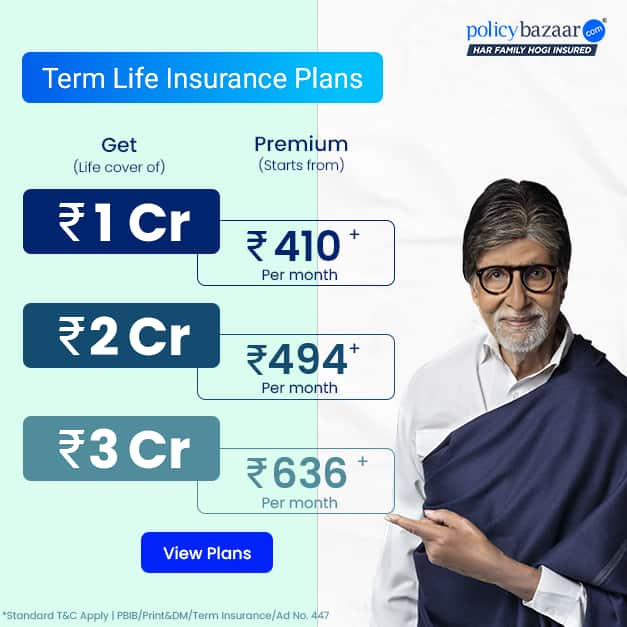
+Rs. 410/month is starting price for a 1 crore term life insurance for an 18 year-old male, non-smoker, with no pre-existing diseases, cover upto 30 years of age, rounded off to nearest 10
+Rs. 410/month (Rs.14/day) is starting price for a 1 crore term life insurance for an 18 year-old male, non-smoker, with no pre-existing diseases, cover upto 30 years of age rounded off to nearest 10
+Rs. 245 is starting price for a 50 lakhs term life insurance for an 18 year-old male, non-smoker, with no pre-existing diseases, cover upto 30 years of age.
+Rs. 8/day is starting price for a 50 lakhs term life insurance for an 18 year-old male, non-smoker, with no pre-existing diseases, cover upto 30 years of age, rounded off to nearest 10
+Rs. 15/day is starting price for a 75 lakhs term life insurance for an 18 year-old male, non-smoker, with no pre-existing diseases, cover upto 30 years of age, rounded off to nearest 10
+Rs. 504/month is starting price for a 1.5 crore term life insurance for an 18 year-old male, non-smoker, with no pre-existing diseases, cover upto 30 years of age.
+Rs. 494/month is starting price for a 2 crore term life insurance for an 18 year-old male, non-smoker, with no pre-existing diseases, cover upto 30 years of age.
+Rs. 636/month is starting price for a 3 crore term life insurance for an 18 year-old male, non-smoker, with no pre-existing diseases, cover upto 30 years of age.
+Rs. 918/month is starting price for a 5 crore term life insurance for an 18 year-old male, non-smoker, with no pre-existing diseases, cover upto 30 years of age.
+Rs. 1,286/month is starting price for a 7 crore term life insurance for an 18 year-old male, non-smoker, with no pre-existing diseases, cover upto 30 years of age.
+Rs. 453/month is starting price for a 1 crore term life insurance for an (NRI) 18 year-old male, non-smoker, with no pre-existing diseases, cover upto 30 years of age.
+Rs.582/month is starting price for a 2 crore term life insurance for an (NRI) 18 year-old male, non-smoker, with no pre-existing diseases, cover upto 30 years of age.
+Rs. 786/month is starting price for a 3 crore term life insurance for an (NRI) 18 year-old male, non-smoker, with no pre-existing diseases, cover upto 30 years of age.
+Rs. 1,374/month is starting price for a 5 crore term life insurance for an (NRI) 18 year-old male, non-smoker, with no pre-existing diseases, cover upto 30 years of age.
+Rs. 1,592/month is starting price for a 7 crore term life insurance for an (NRI) 18 year-old male, non-smoker, with no pre-existing diseases, cover upto 30 years of age.
+Rs. 525/month is the starting price for a 1 crore term life insurance for an 18 year-old male, non-smoker, with no pre-existing diseases, cover upto 68 years of age.
+Rs. 668/month is starting price for a 2 crore term life insurance for an 25 year-old male, non-smoker, with no pre-existing diseases, cover upto 45 years of age.
+Rs. 1,200/month is starting price for a 2 crore term life insurance for an 35 year-old male, non-smoker, with no pre-existing diseases, cover upto 55 years of age.
+Rs. 410/month is starting price for a 1 crore term life insurance for an 18 year-old Female, non-smoker, with no pre-existing diseases, cover upto 30 years of age.
+Rs. 577/month is starting price for a 1 crore term life insurance for an 18 year-old Male, self employed, non-smoker, with no pre-existing diseases, cover upto 30 years of age.
*The full refund of premium is available on availing the one-time option of refund of premium. Total premium paid for policy (paid for add-ons) will be the special exit value, payable on availing the one-time option of refund of premium if you wish to completely exit the policy.
+Rs. ₹361/month is the starting price for a ₹1 crore loan cover with an 8% interest rate for an 18-year-old male, non-smoker, with no pre-existing diseases, loan tenure up to 20 years, rounded off to the nearest 10
Prices offered by the insurer are as per the approved insurance plans | #All savings and online discounts are provided by insurers as per IRDAI approved insurance plans | Standard Terms and Conditions Apply | **Tax Benefits are subject to changes in tax laws.| Policybazaar Insurance Brokers Private Limited
We will respond in the first instance within 30 minutes of the customers contacting us. 30-minute claim support service is for the purpose of giving reasonable assistance to the policyholder in pursuance of the claim. Settlement of claim (including cashless claim) is the responsibility of the insurer as per policy terms and conditions. The 30-minute claim support is subject to our operations not being impacted by a system failure or force majeure event or for reasons beyond our control. For further details, 24x7 Claims Support Helpline can be reached out at 1800-258-5881
For more details on risk factors, terms and conditions, please read the sales brochure carefully before concluding a sale
Policybazaar Insurance Brokers Private Limited | CIN: U74999HR2014PTC053454 | Registered Office - Plot No.119, Sector - 44, Gurgaon, Haryana – 122001 | Registration No. 742, Valid till 09/06/2027, License category- Composite Broker Visitors are hereby informed that their information submitted on the website may be shared with insurers. Product information is authentic and solely based on the information received from the insurers.
© Copyright 2008-2026 policybazaar.com. All Rights Reserved
˜ Policybazaar Promise reflects the guarantee offered by insurers. Price assurance is based on certifications shared by insurers with us.

ABSLI Life Shield Plan Premium starts
Read more
ABSLI Life Shield Plan Premium starts
Read more
ABSLI Life Shield Plan Premium starts
Read more
ABSLI Life Shield Plan Premium starts
Read more
ABSLI Life Shield Plan Premium starts
Read moreInsurance
Calculators
Payment Methods


Secured With

Follow us on


