

 We don't spam

@2x.png)


 Expert advice made easy


Download the Policybazaar app
to manage all your insurance needs.
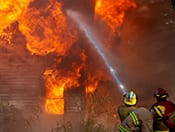
A fire can spread within minutes and leave behind extensive damage to buildings, machinery, inventory and other valuable assets. A suitable fire insurance policy helps businesses and property owners managethese risks by providing financial protection against covered losses.

A fire insurance policy is a contract between the insurer and the policyholder that provides financial compensation for losses caused by fire and other covered perils during the policy period. Depending on the policy selected, it can cover physical damage to buildings, plant and machinery, furniture, stock, raw materials, finished goods, and other business assets.
According to the IRDAI Annual Report 2024-25, India's non-life insurance industry recorded ₹3.08 lakh crore in gross direct premiums during FY 2024-25, reflecting a 6.19%vyear-on-year growth. The steady rise indicates that more individuals and organisations are recognising the importance of protecting their property against unforeseen financial risks.
Many modern fire insurance policies extend beyond fire damage and also provide protection against risks such as lightning, explosions, riots, strikes, storms, floods, earthquakes (through add-ons where applicable), and other specified perils. The scope of protection varies depending on the type of policy and the selected coverage.
Businesses have different insurance needs based on the nature of their assets and operations. Below are the major types of fire insurance policies in India and where each is most suitable.
The Standard Fire and Special Perils (SFSP) Policy is the most commonly purchased fire insurance policy in India. It protects businesses against fire and several allied risks such as lightning, explosion, aircraft damage, storms, floods, riots, strikes, malicious damage, and impact damage.
Best suited for:
The Bharat Sookshma Udyam Suraksha policy is specially designed for micro and small businesses with total insurable assets up to the prescribed IRDAI limit. It offers simplified coverage for buildings, plant and machinery, stock, and other business assets against fire and allied perils.
Best suited for:
The Bharat Laghu Udyam Suraksha policy is intended for medium-sized businesses with higher asset values than those covered under Bharat Sookshma Udyam Suraksha. It provides broader protection while maintaining simplified policy terms.
Best suited for:
Read More: Understand the difference between SFSP, BLUS, and, BSUS
Under a Specific Policy, the insurer agrees to cover assets only up to a predefined sum insured, even if the actual asset value is higher. If the loss exceeds the insured amount, the remaining loss must be borne by the policyholder.
Best suited for:
A Valued Policy fixes the value of the insured property when the policy is purchased. In the event of a covered total loss, compensation is based on the agreed value instead of the market value at the time of loss.
This type of policy is generally suitable for assets whose market value is difficult to determine.
Best suited for:
A Floating Policy provides a single sum insured for similar assets located at multiple locations. Instead of buying separate policies for each warehouse or branch, businesses can insure all eligible assets under one policy.
Best suited for:
A Comprehensive Fire Insurance Policy extends beyond standard fire cover by protecting against a wider range of accidental risks, depending on policy terms and selected add-ons.
Coverage may include:
Best suited for:
Sometimes the biggest financial loss is not the damaged property but the interruption of business after a fire. A Consequential Loss Policy, also known as a Fire Loss of Profit Policy, covers the financial impact of business interruption caused by an insured fire incident.
It may cover:
Best suited for:
| Policy Type | Covers | Ideal For |
| Standard Fire & Special Perils (SFSP) | Fire and specified allied perils | Most commercial businesses |
| Bharat Sookshma Udyam Suraksha | Small business assets | Small enterprises |
| Bharat Laghu Udyam Suraksha | Medium business assets | Medium businesses |
| Specific Policy | Assets up to a fixed sum insured | Selected assets |
| Valued Policy | Agreed value of insured property | Rare or unique assets |
| Floating Policy | Assets across multiple locations | Multi-location businesses |
| Comprehensive Policy | Fire plus wider accidental risks | Large businesses |
| Consequential Loss Policy | Business interruption after fire | Businesses dependent on continuous operations |
Different fire insurance policy types are designed to meet different business requirements. Some focus on protecting physical assets, while others help businesses recover from financial losses caused by operational interruptions.
Most fire insurance policies cover buildings, plant and machinery, furniture, fixtures, stock, raw materials, and finished goods against covered fire-related risks.
Businesses can choose policies based on the value of their assets, industry requirements, number of locations, and operational risks.
Fire insurance policies are available for businesses of different sizes, from small shops and offices to large manufacturing facilities and industrial plants.
Most insurers offer additional covers such as:
These add-ons allow businesses to customize their fire insurance coverage according to their operational risks.
Apart from fire, many policies also cover allied perils such as:
While all fire insurance policies provide protection against fire-related losses, the scope of fire insurance coverage varies depending on the policy selected. Some policies focus on physical assets, while others protect businesses against financial losses arising after a fire.
| Policy Type | Typical Coverage | Best For |
| Standard Fire & Special Perils (SFSP) | Fire, lightning, explosion, storm, flood, riots, strikes, impact damage, aircraft damage and other specified perils | Most commercial and industrial properties |
| Bharat Sookshma Udyam Suraksha | Buildings, plant & machinery, stock and other business assets against standard fire perils | Small businesses |
| Bharat Laghu Udyam Suraksha | Similar to Bharat Sookshma but for businesses with higher asset values | Medium-sized businesses |
| Specific Policy | Losses up to the predefined sum insured | Individual or selected assets |
| Valued Policy | Agreed value of insured property in case of total loss | High-value or unique assets |
| Floating Policy | Similar assets located across multiple locations under one policy | Multi-location businesses |
| Comprehensive Fire Insurance | Fire plus wider accidental risks and optional add-ons | Businesses seeking broader protection |
| Consequential Loss Policy | Loss of profits and increased operating expenses due to business interruption after a fire | Manufacturing and service industries |
Note: The exact scope of coverage may vary depending on the insurer and policy wording.
Choosing among the different types of fire insurance policies in India depends on the nature of your assets and business operations.
Consider the following factors before purchasing a policy:
Evaluate whether you need coverage for buildings, machinery, stock, inventory, or multiple asset categories.
Small businesses may benefit from Bharat Sookshma Udyam Suraksha, while medium and large enterprises often require SFSP or Comprehensive Fire Insurance.
Businesses operating from multiple warehouses or branches may find a Floating Policy more suitable.
If a temporary shutdown could significantly affect revenue, consider adding a Consequential Loss Policy.
Ensure the sum insured reflects the current replacement value of your assets to avoid underinsurance and the application of the average clause during claim settlement.
A fire insurance policy is suitable for almost every business or property owner exposed to fire-related risks.
It is commonly purchased by:
Even businesses operating from rented premises can insure machinery, furniture, stock, and other movable assets.
Conclusion
Different types of fire insurance policies in India are designed to address different business requirements. Whether you need basic protection for a small enterprise, broader coverage for multiple locations, or financial support against business interruption, selecting the right fire insurance policy is essential for protecting your assets and ensuring business continuity.






Insurance
Calculators
Payment Methods


Secured With

Follow us on


