In Unit Linked Insurance Policies, the investment risk is borne by the policyholder. These insurance products do not offer any liquidity in the first 5 years, as they have a mandatory lock-in period of 5 years. During this period, the policyholder cannot fully or partially withdraw the invested amount or surrender the policy.
ULIP Plan
A Unit Linked Insurance Plan (ULIP) is a financial product that combines the benefits of life insurance coverage and market-linked wealth investment in one single plan. In a ULIP plan the policyholder pays the premium, one portion of this premium is used to cover the cost of life insurance which includes mortality and administrative charges. The remaining is invested into market linked investment funds which are managed by fund managers, allowing the policyholder to build corpus by buying units at prevailing Net Asset Value (NAV). The investment risk in this plan is borne entirely by the policyholder, and subject to strict guidelines by the IRDAI.
Knowing how much your investments can grow over time helps you plan your finances more effectively and helps you work towards your financial goals. Various insurance and financial providers offer free online tool i.e. ULIP calculator to give you an estimate of the returns and maturity value, helping you make informed investment decisions.
ULIP Calculator
One Time
Monthly
Yearly
₹
Invest For (in Years)
130
Stay invested for (in Years)
130
Expected rate of return (in %)
135
YOU INVEST
YOU GET
View Plans
What is ULIP (Unit Linked Insurance Plan)?
A Unit Linked Insurance Plan is a financial product that provides insurance coverage and market-linked investment in a single plan. When you pay the premium, one portion goes towards life insurance for family security after the insurance company deducts some charges like mortality, policy administration, etc. The remaining portion is invested in funds such as equity, debt or balanced funds based on your financial goals and risk appetite. The corpus can help you plan for important goals such as child’s education, retirement or wealth creation. ULIP Plans are meant for long term investment because of their strict 5 year lock in policy mandated by IRDAI, which makes them ideal for 10- 15-year goals. Additionally, ULIPs offer tax benefits under Section 123 (formerly Section 80C); maturity proceeds remain tax-free under Section 10(10D) of the Income Tax Act, 1961, subject to conditions like annual premium not exceeding ₹2.5 lakh for policies that are issued on or after February 1, 2021.
How Do ULIP Plans Work?
Understanding how a ULIP plan works can help you understand how your premiums are allocated, how your fund value changes over time, and what benefits you receive at maturity.
Step 1: Premium Payment
You pay premiums regularly, as per the payment option and payment plan you choose, and applicable charges are deducted with respect to your policy terms.
Step 2: Premium Allocation
In the next step, your premium is allocated and divided into 2 parts. A portion of your premium goes towards life insurance coverage, and the remaining amount is invested in funds of your choice.
Step 3: Money Goes Into Funds
You can choose the funds based on your risk appetite and financial goals; the options include equity, debt, or balanced funds. The insurer then allocates the units to your policy at the applicable NAV.
Step 4: Compounding and Tax Free Unlimited Switches
Over time, the amount that you invest benefits from long-term compounding to build a substantial corpus. You also have the flexibility to carry out unlimited fund switches between equity, debt and balanced funds to meet different market cycles or life stages. These switches are completely tax free and does not attract any capital gain tax.
Step 5: Change in the Fund Value
Your investment value falls or rises depending on the market performance of the fund that you choose. You also have the option to switch between funds according to your goals.
Step 6: Receive the Policy Benefit
Once the policy matures, the policyholder receives the total fund value. In some ULIP plans the maturity payout also includes bonuses and loyalty additions and mortality charges that have been collected throughout the policy term are refunded. The policyholder also has the flexibility to choose how they want to receive the money; they can receive it through a lump-sum payout, where the entire amount is paid out once or settlement options where the policyholder can keep the money invested and receive payouts periodically (monthly, quarterly or annually).
Video
information
ULIP - The Truth They Won’t Tell You
PB Trust and Coverage
See how people around you are securing their Goal with Savings Plan from PolicyBazaar
Select State/UT
Total AUM*
₹15,457 Cr.
Your State AUM*
₹420 Cr.
*AUM stands for Assets Under Management. It is the total value of money invested by customers across a set of funds within investment plans.
Types of Funds in a ULIP Plan
ULIP plans can also be classified on the basis of investment funds as well. Each fund carries a different level of risk and returns; depending on your financial goals, risk appetite and investment horizon, you can choose from equity, debt, balanced or other available fund options. Main types of funds available are:
Equity Funds: These types of funds mostly invest in stocks and equity-related instruments. They are aimed at generating long-term capital growth but also carry a high level of market risk.
Debt Funds: These types of funds invest in government securities, corporate bonds, and other fixed income instruments. They are meant for investors seeking stable returns and lower risk than equity funds.
Balanced Funds: These funds invest in a mix of equity and debt instruments and aim to provide balanced growth. The instruments are divided into parts; one goes on the safe side, and the other goes into the risky side of the market, thus balancing the risk and volatility.
Money Market Funds: These types of funds are short term instruments. Short term instruments are liquid and low-risk assets, such as Treasury bills and certificates of deposit. They are low-risk funds and thus offer limited growth as compared to equity funds.
Type 1 vs Type 2 ULIP Plans
ULIPs are classified based on their purpose and death benefit. Let us learn about them in detail.
ULIPs come in two types: Type 1 prioritizes life coverage with a higher payout on demise, while Type 2 emphasizes investment, offering the fund value on death. Both types allow customization for diverse financial goals.
Parameter
Type 1 ULIP Plans
Type 2 ULIP Plans
Death Benefit
Upon death, these plans pay the nominee either the life cover amount or the current fund value, whichever is higher.
Example: If your investments have increased to ₹50 Lakh and your life cover is ₹40 Lakh, your family gets ₹50 Lakh.
With these plans, the nominee gets both life cover and investment value. Because it pays out both, the premiums are usually higher, but the final payout is much larger. For instance, if your life cover is ₹40 lakh and your investment grows to ₹50 lakh, the nominee receives ₹90 lakh in total.
Lock-in period
5 years
5 years
Investment options
Equity, debt, or a mix of both
Equity, debt, or a mix of both
Returns
Market-linked returns
Market-linked returns
Objective
Guaranteed death benefit payout
Higher returns
Suitable for
Risk-tolerant investors
Risk-tolerant investors
Sum at Risk
As the fund value steadily increases over time, the amount of risk faced by the insurance company decreases correspondingly.
The insurer will pay the sum assured as death benefit. The sum at risk will remain constant year after year even as the fund value grows and becomes higher than sum assured.
New Age and 4G ULIP Plans
New-age ULIPs, often called 4G ULIP plans, have changed the game by cutting out the heavy costs that used to eat into your returns. Unlike older versions, these don't charge you for premium allocation or policy administration, meaning more of your money actually goes into the market. Features like mortality charges that are returned upon your policy's maturity help provide you with free life cover if you outlive the policy term. It is a much better investment strategy that concentrates on keeping your wealth intact, instead of filling your insurer’s pocket with high fees.
We’ve stood by families when they needed us most.
Because some promises should last a lifetime
Benefit Amount
₹396*
Crore
Since 2018
Total Claims
3,550
Processed
States/UTs
30
Across India
Cities
464
Coverage
Life Cover + Income Benefit + Premium paid by insurance companies + Maturity Value basis 12%
Directly From Experts
When building wealth for the future, the true test of any financial product isn't just how well it compounds your capital during good times, but how bulletproof it keeps your financial objectives when life takes a turn.
The track record speaks to this trust: since 2018, over ₹396 Crore has been delivered across 3,550 claims processed, spanning 464 cities and 30 States/UTs. Beyond market returns, the defining feature here is Goal Protection. If you are no longer there to pay the premiums, the policy takes over the payments for you, allowing the investment to grow uninterrupted until maturity for your family.
My advice to every investor: invest for high upside, but lock it in with protection. A ULIP with Goal Protection turns an uncertain financial journey into a guaranteed path toward fulfilling your family's dreams.
According to the Allied Market Research report the global ULIP market hit $1.1 trillion in 2024 and is expected to hit $3.3 trillion by 2034 with a 10.5% CAGR over the period, according to 27 November 2025’s report. (Source: Allied Market Research's Unit-Linked Insurance Market report)
The life insurance market in India stood at $110.6 billion in 2024 and is still continuing to grow on a yearly basis. The number below from the IMARC group report shows the breakdown of where the market stands today and how the ULIPs are expected to grow going forward.
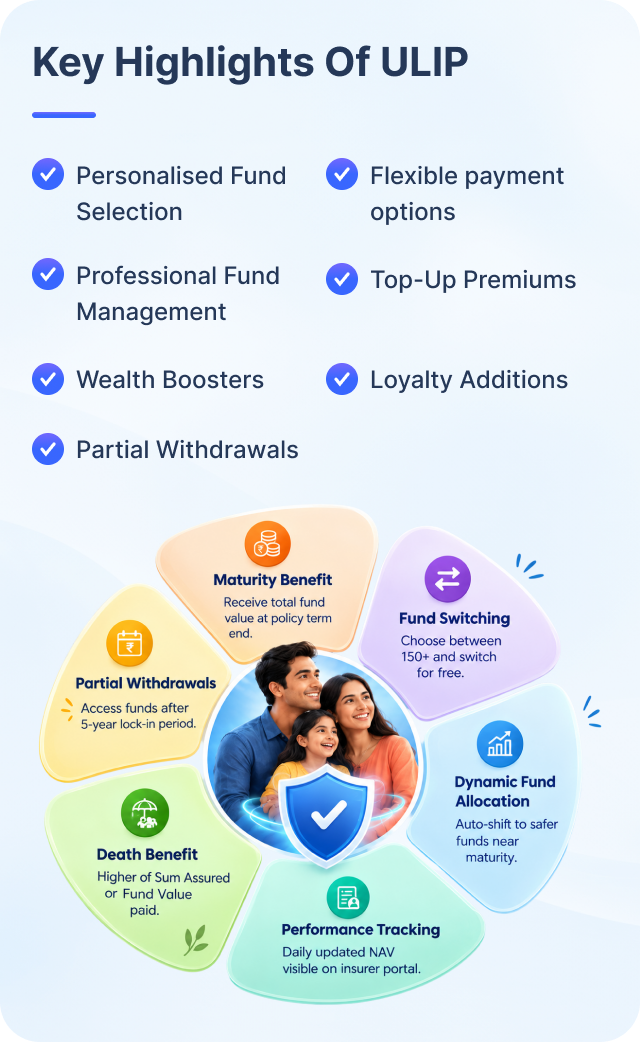
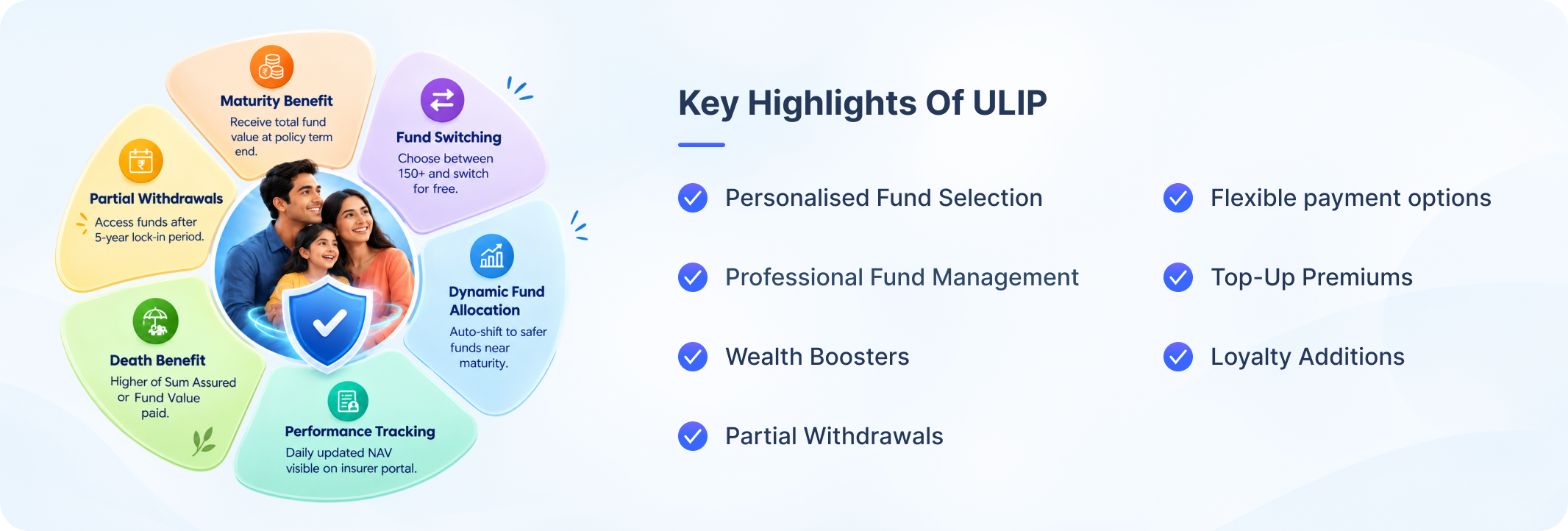
Choice of Investment Funds: In a ULIP plan, you get to choose from different types of fund options available based on your risk appetite and financial goals. Options can include equity, debt, balanced or other fund options, each having a different level of risk and returns.
Flexible Premium Payment Options: ULIP plans offer different premium payment options like regular or limited premium payments. This structure allows you to choose a payment plan that suits your income and financial planning needs.
Fund Management: The investment part of your ULIP premium is managed by a professional fund manager. They invest the investment part of your money according to your financial objectives and your future needs.
Top Up Premiums: Through this feature in a ULIP plan, you can invest additional money to your policy when you have extra funds. This increases the invested amount in the funds of your choice, which ultimately helps you in building a larger corpus over time.
Loyalty Additions: If you stay invested in a ULIP plan without discontinuing it, the insurer will add extra units to your fund periodically as a staying invested bonus and reward the consistent behaviour of the policyholder.
Partial Withdrawal: Once the ULIP lock-in period of 5 years is over, you are allowed to partially withdraw money from your policy in case of any emergency. The policy will continue running as usual, just with a little reduced corpus.
Types of Premium Payment Terms in a ULIP Plan
Regular Premium: In this type, the policyholder pays the premiums at fixed intervals such as monthly, quarterly, half-yearly, or annually, as allowed in the policy. This supports disciplined investing.
Single Premium: Policyholders pay the entire premium in one go, i.e. in a lump sum at the start of the policy. This type suits individuals who have surplus funds available for investing.
Limited Premium: The policyholder pays premiums for a specific time period that is usually shorter than the overall policy term. The policy continues even after the premium payment period is over and the policyholder enjoys its benefits without any worries.
Example for limited premium: Suppose you buy a ULIP Plan with 20 year policy term and 10 year premium payment term.
You will have to pay premiums only for the first 10 years.
Even after you stop paying (after 10 years), your investments remain linked to the market and may keep growing for the next 20 years.
6 Benefits to Consider of ULIP Plans
Planning your financial future requires balancing financial growth and also protecting your loved ones. ULIP plans help you work towards both goals by providing you with life insurance coverage and market-linked returns. Apart from these, ULIPs have a lot to offer; below are the key benefits worth considering:
Wealth Creation that is Market-Linked
ULIPs invest a part of your premium in market-linked funds such as equity, debt or balanced funds, depending on your financial preference. Your investment then grows as per the fund’s performance, the value of your fund may increase or decrease over time. Staying invested for a long term in a ULIP plan can help you build a corpus for your future financial needs.
Goal Based Investment
ULIPs are designed in a way that can be used to build a corpus for your long term goals, such as retirement, children’s education, or buying a house. You are allowed to choose investment funds of your choice, based on your risk appetite and financial goals, which in turn helps your investment grow based on your financial goals.
Life Insurance Protection Alongside Investment
Apart from the investment part, there is another part of your ULIP premium that makes sure that you have life insurance cover throughout the policy term in your ULIP plan. If something unfortunate happens to you during the policy term, the nominee receives the eligible death benefit, providing financial support to your family during tough times. This ensures your family remains secure even when you are not around.
Tax Benefits
The premiums that you pay towards your ULIP plan may qualify for tax deductions under Section 123 (formerly Section 80C of the Income Tax Act, 1961) under the old tax regime. The maturity or death benefit will enjoy tax exemption as per Section 10(10D) of the Income Tax Act 1961 [now Schedule II, Clause 2 (Schedule II(2))]. These tax benefits help the policyholder with proper financial efficiency.
Disciplined Long Term Investment
The way ULIP plans are structured encourages the investors to remain invested for a long term by paying regular premiums. By staying invested for such a long time helps with the power of compounding and for growing your investment while managing the market fluctuations properly. This ultimately develops financial discipline and supports your long term financial goals.
Flexibility to Change Investment Funds
ULIP plans allow you to change or switch between the available investment funds based on your changing financial needs and risk appetite. For example, you can choose the equity funds option for higher growth and move towards debt funds if your financial goals are nearing.
ULIP Charges to Know
ULIP Plans do have certain charges associated with them, these ULIP charges can be subdivided into multiple categories. Following are the ones you must know:
Premium allocation charge: The fee charged by the insurance company for allocating the premium amount to various investment funds. Premium allocation charge ranges between 0-5% of the premium, but the newer ULIP plans come with almost 0 charges.
Fund management charge: The fee charged by the fund manager for managing the investment portfolio of the ULIP. IRDAI has capped this charge at 1.35% per year.
Mortality charge: The fee charged by the insurance company for providing the life cover under the ULIP. There is no single percentage because it varies according to the plan.
Policy administration charge: The fee charged by the insurance company for maintaining the policy record and providing services. IRDAI has capped the charge at 2.25% per annum or ₹500 per month, whichever is lower.
Surrender charge: The fee charged by the insurance company if the policyholder decides to surrender the policy before the end of the lock-in period. The amount depends on your annualised premium and the policy year you are exiting. After 5 years, it is strictly ₹0
Switching charge: The fee charged for switching between different investment funds. Usually, the policy provides 4 to 12 free fund switches in a year.
Partial withdrawal charge: The fee charged for making partial withdrawals from the investment corpus. Almost every policy provides a set number of free partial withdrawals which is 2 to 4 withdrawals.
Discontinuance Charges: On premature discontinuation of a plan within the lock-in period, the insurer deducts a small fee. Since these charges are preset by IRDA, these are the same for almost all policies.
Rider Charge: If you add optional covers like an accidental death benefit or critical illness rider, a separate charge applies for each. The cost depends on the rider you pick and your risk profile.
What is Lock-in Period in ULIP Plans
According to the mandate set by IRDAI, the lock-in period for every ULIP sold in India is fixed at 5 years. Until that period ends, your fund value stays locked, you can not fully surrender or make partial withdrawals from ULIP investments
Rules for the Lock-in Period:
There is no option of taking out or redeeming the fund value during this period
You are allowed to switch your money between funds of your choice which could be equity, debt or balanced funds during this time.
Your life insurance coverage will continue as long as you continue paying regular premiums on time
If you discontinue the policy early, the money is transferred into a discontinuance fund and is released only after the lock-in ends.
After the 5 years are over, partial withdrawals become available, and the policy continues as usual with slightly reduced corpus.
How Does the Payout Work in a ULIP Plan in Various Situations
Consider the case of Rohan, a 35-year-old software engineer, who purchases a ULIP to build a corpus for his son's higher education and his own early retirement.
Basic Policy Details
Particulars
Details
Monthly Premium
₹10,000
Annual Premium
₹1,20,000
Policy Term
30 years
Sum Assured
₹12 lakh
Investment Choice
Equity Oriented Fund
How is Rohan’s Premium Invested?
When Rohan pays his monthly premium of ₹10,000 applicable charges are deducted before the remaining amount is invested in a ULIP
Particulars
Illustrative Amount
Monthly Premium
₹10,000
Premium Allocation Charge
₹300
Amount Invested in the Fund
₹9,700
Mortality Charge
₹200
Policy Administration Charge
₹100
Fund Management Charges
1.35% annually, adjusted through the NAV
The fund management charge (FMC) is assumed to be 1.35% annually. It is adjusted through the fund’s NAV rather than deducted upfront from ₹9,700 Note: All charge amounts above are just hypothetical and used only for illustration purposes. The actual charges vary by plan.
Scenario 1: If Rohan Passes Away During the Policy Term
Suppose Rohan dies after six years.
Particulars
Illustrative Amount
Monthly Premium
₹7,20,000
105% of Total Premiums Paid
₹7,56,000
Fund Value
₹9,18,000
Sum Assured
₹12,00,000
Death Benefit
₹12,00,000*
The death benefit is either sum assured or fund value or 105% of total premiums, whichever is higher and subject to policy terms. In this case, the sum assured amount is higher so Rohan’s nominee will receive ₹12,00,000
Scenario 2: If Rohan Completes the 30-Year Policy Term
Suppose Rohan continues paying premiums until maturity (30 years):
Particulars
Amount
Monthly Premium
₹10,000
Annual Premium
₹1,20,000
Policy Term
30 years
Total Premium Paid
₹36,00,000
Assumed Annual Return Before FMC
8%
Assumed FMC
1.35% per annum
Approximate Annual Return After FMC
(8%-1.35% FMC charge) = 6.65%
Maturity Benefit
Depends on fund performance and applicable charges
Rohan receives the final fund value at maturity, the actual amount depends on the market performance and the applicable charges.
Scenario 3: If Rohan Wants to Surrender the ULIP Plan Before Completing 5 Years
Rohan pays ₹10,000 per month, so his total premiums over 3 years would be:
Step 1: Calculate the Fund Value After 3 Years:
Particulars
Amount
Monthly Premium
₹10,000
Total Premiums Paid (₹10,000 x 36 months)
₹3,60,000
Mortality Charge (₹200 x 36)
₹7,200
Premium Allocation Charge (₹300 x 36)
₹10,800
Policy Administration Charge (₹100 x 36)
₹3,600
Total Assumed Policy Charges
₹21,600
Monthly Invested Amount
₹9,400
Assumed Annual Return Before the Fund Management Charges (FMC)
8%
Assumed FMC
1.35% annually
Approximate Annual Return
6.5%
Fund Value After 3 Years (Estimated)
₹3,73,377
The estimated fund value is calculated using a monthly investment of ₹9,400 for 36 months, assuming an annual return of 8% before the fund management charges (FMC) and an FMC of 1.35% per annum. The actual fund value depends on market performance and policy terms.
Step 2: Calculate the Amount Transferred to the Discontinued Policy Fund
Assuming the discontinuance charge of ₹4,000
Particulars
Amount
Estimated Fund Value
₹3,73,377
Assumed Discontinuance Charge
₹4,000
Amount Transferred to DPF
₹3,69,377
Step 3: Amount After 5 Year Lock-in
The amount transferred to the Discontinued Policy Fund earns interest at the applicable minimum guaranteed rate of 4% per annum mandated by IRDAI. But there is fund management charge (FMC) which is capped at 0.50% per annum.
The net annual returns would be (4% interest - 0.50% FMC = 3.5%)
Particulars
Amount
Amount Transferred to DPF
₹3,69,377
Interest for Year 1 at 3.5% with respect to above net returns
₹12,928
Balance After Year 1
₹3,82,305
Interest for Year 2 at 3.5% with respect to above net returns
₹13,381
Estimated Amount After 2 Years
₹3,95,686
Rohan will receive approximately ₹3.96 lakhs after the lock-in period of 5 years is over assuming the annual rate of return of 3.5%.
ULIP Plans Tax Benefits and Taxation Rules
Under the latest Income Tax Act, 2025 (which has replaced Income Tax Act, 1961) premium deductions previously which were claimed under Section 80C are now covered under Section 123 (Schedule XV), while the tax exemptions which were earlier claimed under Section 10(10D).
Below are the tax rules and regulations that a policyholder should be aware of:
ULIP Tax Benefits Summary
Policy Cycle
Applicable Condition
Tax Treatment and Sections
Premium Payment Stage
Under Old Tax Regime
Tax deduction up to ₹1.5 Lakh per financial year under Section 80C (provided annual premium is <= 10% of Sum Assured).
Under New Tax Regime
No Deductions are Available
Growth Phase of the Plan
Fund Switching between Equity or Debt
100% tax free switching between funds attracts 0 capital gains tax or TDS
Maturity/Surrender Proceeds (Policies bought on/after Feb 1,2021)
Collective Annual Premium <= ₹2.5 Lakh
100% tax exempt on maturity under Section 10(10D) (provided sum assured is >= 10x annual premium)
Collective Annual Premium > ₹2.5 Lakh(Holding Period > 12 Months)
LTCG @ 12.5% on net gains exceeding ₹1.25 Lakh per financial year (treated as an equity-oriented asset; no indexation).
Collective Annual Premium > ₹2.5 Lakh(Holding Period <= 12 Months)
STCG @ 20% on total capital gains
Death Benefit (Payout to nominee)
Any premium amount (even if > ₹2.5 lakh)
100% Tax Free under Section 10(10D) in all conditions. No TDS applies.
Partial Withdrawals (Post 5 Year Lock in)
Collective Annual Premium <= ₹2.5 Lakh
Tax free up till you reach the collective fund value
Collective Annual Premium > ₹2.5 Lakh
Capital gains taxed under the equity capital gains framework.
Surrender/Discontinuance
Before mandatory 5 year lock in period
Proceeds move to a Discontinued Policy Fund. Deductions previously claimed under Section 80C are reversed and taxed as income in the year of surrender.
ULIP Tax Benefits Details
ULIPs are not fully tax-free, but they do carry solid tax benefits on both ends. The premium you pay qualifies for a deduction of up to ₹1.5 lakh a year under Section 123 (previously Section 80C), and the maturity payout is tax-free under Schedule II(2) of the Income Tax Act, 2025 [previously Section 10(10D)] as long as your annual premium stays at or below ₹2.5 lakh for policies issued after 1 February 2021. Cross that ₹2.5 lakh mark and the gains get taxed as capital gains. So a ULIP is better described as tax-efficient than fully tax-free. Keep your premium within the limits, and you hold on to most of these benefits without a catch. Below are the tax benefits of ULIP plan under each section explained in detail:
Tax Benefit Under Section 80C (now Section 123 of the Income Tax Act, 2025)
ULIP premiums qualify for a deduction of up to ₹1.5 lakh in a financial year under Section 123 (formerly Section 80C). One condition applies here. Your life cover has to be at least 10 times your annual premium to claim the full amount. If the cover is lower than that, your deduction gets capped at 10% of the sum assured. This benefit is available only if you file under the old tax regime. If you have moved to the new regime, the 80C deduction on ULIP premiums does not apply.
Tax Benefit Under Section 10(10D) (now Schedule II(2) of the Income Tax Act, 2025)
Maturity proceeds from a ULIP are tax-free under Section 10(10D) (now Schedule II(2) of the Income Tax Act, 2025), subject to conditions.
For any policy issued before 1 February 2021, the maturity amount stays tax-free no matter how high your yearly premium was.
For policies issued on or after that date, the exemption holds only if your total annual premium stays at or below ₹2.5 lakh.
The death benefit paid to your nominee is always tax-free, regardless of the premium amount or when the policy was bought.
Watch out for the aggregation rule. The ₹2.5 lakh limit applies to the combined premium across all your ULIPs, not each policy on its own.
So if you hold two ULIPs bought after 1 February 2021 and their premiums together cross ₹2.5 lakh, both fall outside the exemption.
Are ULIP Plans Tax Free?
Budget 2025 cleared up a long-standing grey area around high-premium ULIPs. Earlier, there was confusion over whether the gains from these policies should be treated as income from other sources or as capital gains. The rules now state plainly that a ULIP which does not qualify under Schedule II(2) of the Income Tax Act, 2025 [previously Section 10(10D) of the Income Tax Act, 1961] is treated as a capital asset, and its gains are taxed as capital gains. These changes take effect from 1 April 2026 and apply to assessment year 2026-27 onwards.
Here is how the tax works for a ULIP that falls outside the 10(10D) exemption:
If you hold the policy for more than 12 months, the gain is a long-term capital gain, taxed at 12.5% on the amount above ₹1.25 lakh.
If you exit within 12 months, the gain is a short-term capital gain, taxed at 20%.
This brings high-premium ULIPs closer to how equity mutual funds are taxed. One advantage still sets ULIPs apart though. Switching between equity and debt funds inside the plan during the policy term does not trigger any capital gains tax. In a mutual fund, every switch counts as a redemption and can attract tax.
There is one more recent change worth noting. From 22 September 2025, GST on individual life insurance premiums, ULIPs included, has been brought down to NIL for premiums due on or after that date. This lowers the effective cost of holding the policy, since you are no longer paying tax on top of your premium.
ULIP vs. Mutual Funds vs. PPF vs. Term Insurance
Feature
ULIP (Unit Linked Insurance Plan)
Mutual Funds
PPF (Public Provident Fund)
Term Insurance
Purpose
Dual benefit of investment and life insurance coverage
Wealth creation and investment growth
Long term capital preservation and guaranteed savings
Pure life protection / Financial security for family if something happens to policyholder
Life Insurance Cover
Yes (min 10x of annual premium)
No
No
Yes
Maturity / Survival Benefit
Yes, the fund value is paid out at maturity
Yes, total value of fund units are redeemed
Yes, accumulated balance is paid out on maturity
No, zero payout upon survival
Risk Level
Depends on the fund selected and is borne by the policyholder
Low to high depending on fund category
Low (government guarantee)
No investment risk
Lock-in Period
5 years
None except ELSS which has 3 years
15 years which is extendable in the blocks of 5 years
Not applicable
Liquidity & Withdrawals
Partial withdrawals are allowed after completing 5 policy years
Units can be redeemed anytime at the prevailing NAV
Partial withdrawals allowed from the 7th financial year and loan facility is available from 3rd year
No liquidity or loan against policy available
Tax Benefit on Investing
Deductions under Section 80C up to ₹1.5 lakh (Old Tax Regime)
Deductions under Section 80C up to ₹1.5 lakh only for ELSS funds (Old Tax Regime)
Deductions under Section 80C up to ₹1.5 lakh (Old Tax Regime)
Deductions under Section 80C up to ₹1.5 lakh for premiums paid (Old Tax Regime)
Tax on Payout
Tax-free under Section 10(10D) if total annual premium is up to ₹2.5 lakh; capital gains tax applies above that threshold
Subject to Capital Gains Tax (STCG/LTCG based on mutual fund type and holding period)
Fully tax-free (EEE status: investment, interest, and maturity are exempt)
Death claim payouts are completely tax-exempt under Section 10(10D)
Charges & Costs
Premium allocation, policy administration, mortality, and fund management charges
Total expense ratio and exit load charges
Almost 0 charges
Premium charges (administrative and underwriting mortality costs)
Regulatory Authority
IRDAI
SEBI
Ministry of Finance
IRDAI
Best for
Long term investors wanting life cover + market exposure in one product
Investors wanting liquidity and different fund choices
People looking for security and government backed long term savings
Individuals seeking financial security for their family
Maximising Returns
How ULIPs outperforms other Market linked instruments in LTCG Efficiency
Investment Amount
₹10,000/month
Investment Tenure
10 Years
Withdrawal After
20 Years
ULIP
Other Market Linked Product
Total Investment Amount
Estimated Returns
Corpus after 20 years
Capital Gain
Exemption on LTCG
LTCG rate
Tax Amount on LTCG
GST
Additional Maturity
Total Amount you get at Maturity
₹12 Lakh
15%
₹1.06 Crore
₹94 lakh
₹1.25 Lakh
0%
₹0
0%
₹4 Lac
₹1.06 Crore
₹12 Lakh
15%
₹1.06 Crore
₹94 Lakh
₹1.25 Lakh
12.5%
₹11.6 Lakh
18%
₹4 Lac
₹94 Lakh
With 0% GST and LTCG tax (upto 2.5 Lacs annual investment amount) and comparable returns, ULIPs offer a clear advantage over Other Market Linked Product, maximising your overall benefit at maturity.
Can I Cancel or Surrender My ULIP Plan?
Yes, you can surrender your ULIP before completing 5 years, but the money is not immediately available for withdrawal. ULIPs have a lock-in period of 5 years, so after surrendering or discontinuing, the amount is transferred to a discontinuance fund, where it remains until the lock-in period is completed. A discontinuance charge may also apply, subject to the limits prescribed by IRDAI. Once the lock-in is over, you can surrender the ULIP and receive the fund surrender value based on the applicable NAV on the date of surrender, without any charges. If you need only part of your investment, a partial withdrawal may be an alternative to closing the policy completely.
Common Riders Available With a ULIP Plan
Riders are small add-ons you can attach to your ULIP for a little extra premium. They cover gaps the base plan does not. Common ULIP plan riders are:
Accidental Death Benefit Rider: Extra payout to your nominee if death is caused by an accident.
Critical Illness Rider: A lump sum if you are diagnosed with a listed illness like cancer, kidney failure, or a heart condition.
Waiver of Premium Rider: If you die or become disabled and cannot pay, the insurer pays your future premiums and the policy continues. Very handy in child plans.
Permanent Disability Rider: Pays out if an accident leaves you permanently disabled and unable to earn.
Income Benefit Rider: Your family gets a regular income for a set period instead of one lump sum.
Is ULIP Suitable for You?
Your situation
What to consider
Need pure life protection
Term insurance
Want flexible market-linked investment
Mutual funds
Want life insurance + investment in one product
ULIP
Need money within 3–5 years
Carefully evaluate ULIP liquidity and lock-in or you can choose SIP
Have a long-term wealth creation goal
ULIP may be considered
Planning for your child's education
Compare ULIP with mutual funds and child plans with waiver of premium features
Planning for retirement
Compare ULIP with NPS and other retirement options
Who Should Consider ULIP Plans?
Staying in for the long run: Don't go into ULIPs expecting to pull cash out in a year or two. The whole thing works on time. Five years is the floor, and the longer you leave it, the better your odds of riding out a bad market and still coming out ahead.
You are saving for a specific goal: These work best when you have a big future expense in mind, like retirement or your child's education. The lock-in actually helps here, since it keeps you from dipping into the money and lets it grow toward that goal.
You want insurance and investment together: ULIP investment gives you life cover and market exposure in one plan. Be honest with yourself about how much risk you can take, because your returns depend on the funds you pick.
Who Should Not Consider ULIP Plans?
You may need the money soon: The five-year lock-in makes ULIPs a poor fit if there is any chance you will need to pull the money out early. Exiting before the lock-in ends wipes out most of the benefit and can trigger charges.
You only want life cover: If your goal is pure protection for your family, a term plan gives you a much larger cover for a far smaller premium. Bundling insurance with investment usually means paying more for less cover.
You are not comfortable with market risk: ULIP returns rise and fall with the market. If the ups and downs would make you anxious, or you cannot afford a dip at the wrong time, a fixed-return option like PPF or an FD may suit you better.
How to Choose the Best ULIP Plans in India?
List down your goal first: Saving for a child's education, a house, or retirement, each goal has its own time frame, and that should shape the plan you go for.
Match the fund to your risk appetite: Go equity-heavy if you have years to ride out the market and can stomach the ups and downs. Lean towards debt if you want steadier, safer growth.
Check the fund's track record: Look at how the insurer's funds have performed over 5 to 10 years, not just the last good year. Consistency matters more than one strong run.
Read the charges closely: Premium allocation, fund management, and policy admin fees all chip away at your returns. Lower charges leave more of your money invested.
Look at fund-switching flexibility: A good ULIP lets you move between equity and debt freely as your goals or the market shift, and the switches stay tax-free.
Confirm the life cover is enough: The investment side is only half the plan. Make sure the Sum Assured actually protects your family, not just your savings target.
Go for low-cost plans: New-age ULIPs with zero allocation charges leave more of your money in the market. Even a small gap in fund management charges adds up once it compounds.
Start early: The sooner you begin, the longer compounding gets to run. Starting at 28 instead of 35 can mean a noticeably bigger corpus, even with smaller premiums.
Mistakes to Avoid When Investing in ULIP Plans
Ignoring Risk Tolerance
ULIPs follow the market, so returns will go up and down. Pick a fund mix that actually fits how much risk you can handle.
Short-Term Goals
ULIPs aren't for quick cash. With a five-year lock-in and market ups and downs, they only make sense if you're prepared to leave your money alone for years.
Focusing Only on Tax
Don't buy a policy just to dodge taxes. Tax benefits are an added advantage, but the investment should first align with one's financial capacity and goals.
Frequent Switching
Moving money too often can ruin your long-term growth. Stick to a solid plan instead of reacting every time the market shifts.
Underestimating the Timeline
Don't cut your time short. Staying invested for years is the only way to beat market volatility and actually reach your targets.
Current ULIP Regulations and Market Scenario in India
Money in a discontinued ULIP does not sit idle. It moves to the Discontinuance Policy Fund, which carries a minimum guaranteed return of 4% a year, and only the fund management charge can be deducted from it during that period. (Source: IRDAI (Treatment of Discontinued Linked Insurance Policies) Regulations, 2010)
Switching between equity and debt inside a ULIP does not trigger capital gains tax. In a mutual fund, every switch counts as a redemption and is taxed on its own holding period. (Source: Income Tax Act treatment of ULIP fund switches)
India's overall insurance penetration was flat at 3.7% of GDP in FY2024-25 and life insurance penetration slipped to 2.7% from 2.8%. The global average is 7.3%. (Source: IRDAI Annual Report 2024-25)
Before buying a ULIP plan the insurer will ask for a few basic documents that mainly cover KYC verification and proof of income so it's important to keep these documents handy at the time of purchase to avoid delays. The documents required are as follows:
Purpose
Documents Accepted
KYC (Identity & Address)
PAN card, Aadhaar card
Proof of Income
Salary slips, Income Tax Returns (ITR), and recent bank statements
How to Buy a ULIP Plan Through Policybazaar
Step 1: Enter Your Details
Simply go to policybazaar’s ULIP page and fill in basic details like name and phone number to get personalized quotes.
Step 2: Compare & Select the Plan Fit for You
You can compare plans across 53 insurance companies according to your financial goals. Filter the funds according to their performance and plans with zero charges. You can use Policybazaar’s comparison tools and compare plans based on 3Y, 5Y, and 10Y fund returns and goal based funds available.
Step 3: Select Investment Premium & Cover Amount:
Choose the ULIP plan that fits your financial goals and risk appetite and then choose the option for your monthly or yearly premium payment along with desired death benefit cover. Payment takes less than 2 minutes.
FAQs
Who bears the investment risk in case of ULIPs?
The investment risk in ULIPs is borne by the policyholder, as the returns are linked to the performance of the underlying market-linked funds.
What happens if I can’t continue ULIPs after 5 years?
If you stop your premiums after five years, the policy closes immediately and you get your total savings back. Because you’ve finished the five-year lock-in, the insurer can't take out any exit fees or penalties. You simply walk away with every rupee that's sitting in your fund.
Is ULIP better than FD?
Neither a ULIP, nor a fixed deposit (FD) is better, they serve different purposes. A ULIP is a long term, market-linked product that also provides the benefits of life insurance, whereas a fixed deposit is a low-risk capital protection and guaranteed income product provided by banks.
Are ULIPs safe for conservative investors?
Yes, because you have control. While ULIPs are market-linked, you don't have to put your money in the stock market. You can choose 100% Debt or Liquid funds, which invest in government bonds and fixed-income tools. This gives you the security of a traditional plan and the benefit of being able to see exactly where every rupee is going.
What is the return of ULIP after 10 years?
There's no fixed return in ULIPs since performance depends on the fund option you choose and market conditions. Equity-oriented ULIP funds have historically delivered anywhere between 8% to 12% CAGR over a 10-year period, though this varies by insurer and fund. Debt or balanced funds within ULIPs tend to give lower but more stable returns. The longer you stay invested, the more the compounding works in your favour and after 10 years, the impact of charges also reduces considerably.
How much money will I get if I surrender my ULIP after 5 years?
You'll receive the fund value as on the date of surrender, meaning the total units accumulated in your chosen fund(s) multiplied by the NAV at that time. There are no surrender charges after the 5-year lock-in period. However, the actual amount will depend on market performance, the fund you chose, and how much premium you've paid.
What are the main benefits and limitations of investing in a ULIP?
Main benefits: You get tax benefits on a ULIP plan through deductions under Section 80C and tax-free maturity under Section 10(10D). ULIPs also help with goal based milestones, retirement or child’s education since they are designed for long-term goals (10-15+ years).
Limitations: ULIPs do carry some high front end charges that are higher compared to pure mutual funds. Additionally, the market risk is something that a policyholder needs to bear.
Can we change the premium amounts during the policy term?
No, all regular and limited premium paying ULIP plans must have the same premium amount throughout the policy term.
How are ULIP charges regulated across the policy term?
Insurers cannot front load ULIP charges excessively in the first few years, fees must be distributed evenly across the 5 year lock in period. From the 5th year onwards, IRDAI imposes a strict cap on total charges so that it can protect policyholders fund value.
Is ULIP good for investment?
Unit Linked Insurance Plans (ULIP) can be a good investment only if you want a single product that combines both life insurance and scope for market linked wealth creation. ULIP plans can be more expensive than buying insurance and investments separately.
Are Non-Resident Indians (NRIs) and OCIs legally allowed to invest in a ULIP plan in India?
Yes, under the Foreign Exchange Management Act (FEMA) and Reserve Bank of India guidelines, NRIs and OCIs are allowed to purchase ULIP plans offered by Indian life insurance companies.
Are the maturity and death benefit proceeds repatriable abroad from a ULIP plan?
Premiums paid via NRE / FCNR account or direct foreign remittance: Maturity and death proceeds are freely repatriable back to the foreign country (India), the policy holder must submit Form 15CA/15CB (tax clearance documentation).
Premiums paid via NRO account: Payouts must be credited to an NRO account and fall under the RBI’s Liberalised Remittance / NRO remittance limit of up to USD 1 million per financial year.
Written By:Sameep Singh
Sameep Singh Savings Business Head (MBA in Finance), Policybazaar
Mr. Sameep Singh is a Business Unit Head for the domestic Investment Business at policybazaar.com, holding a master's from Symbiosis School of Banking & Finance. He has played a pivotal role in crafting investment and term business strategies during his tenure at Policybazaar. His exceptional leadership has been instrumental in driving both product and business growth throughout his impressive career.
Reviewed By:Vivek Jain
Vivek Jain Chief Business Officer – Life Insurance, Policybazaar
Mr. Vivek Jain Chief Business Officer – Life Insurance at Policybazaar, is a seasoned business leader with over a decade of experience across strategy, customer experience, and digital transformation in financial services. An alumnus of IIM Calcutta, he leads Policybazaar's life insurance business with a focus on helping Indian families build financial resilience through protection, long-term savings, and wealth creation. A strong advocate of goal-based financial planning and disciplined investing, his expertise spans ULIPs, guaranteed savings and child plans, retirement planning, NRI investments, and tax-efficient wealth creation. His perspectives have featured in The Economic Times, Mint, Financial Express, Zee Business, Gulf News, and Rediff.
ULIPs provide an investor with the option to customise their ULIP by attaching several riders on top of their
Read more
Reviews & Rating
4.7 / 5
(Showing Newest 10 reviews)
S
Sangeeta
Bhopal, October 31, 2026
Very Pleased With Service
"Bharti axa efuture invest plan policybazaar advisor helped me understand fund allocation properly which i was struggling with on my own overall a good experience buying this ulip"
R
Rohit
Ranchi, October 30, 2026
Fine Plan So Far
"edelweiss life wealth plus rising star took it few months back too early to comment on returns but the buying process through policybazaar was quick and painless"
C
Chitra
Indore, October 29, 2026
Amazing Support Throughout
"generali central easy invest online plan works well for my monthly savings goal policybazaar advisor followed up even after purchase to check if everything is fine nice touch"
Y
Yogesh
Nagpur, October 28, 2026
Trustworthy Platform
"Lic india siip comparing plans on policybazaar site was easy could see charges and fund performance side by side bought this plan and happy with the transparency"
L
Lata
Agra, October 27, 2026
Good For Long Term Goals
"Star union dai ichi life ewealth royale me and my husband both discussed and decided on this through policybazaar advisors suggestion process was clear no hidden surprises so far"
OP
Om
Faridabad, October 26, 2026
Solid Choice
"canara hsbc life promise4wealth maximiser took this plan few months back so far returns are okay not amazing but okay policybazaar customer service has been responsive whenever needed"
N
Nisha
Salem, October 23, 2026
Loved The Process
"Kotak mahindra life e invest plus plan chose it for the fund options variety policybazaar team sent me all documents on email same day very organised process"
S
Swati
Solapur, October 23, 2026
Very Satisfied
"Bajaj life smart wealth goal vii bought this after my colleague recommended policybazaar whole kyc and everything done online in one sitting didnt expect it to be this fast"
H
Harish
Jalandhar, October 23, 2026
Good Plan For Beginners
"Birla sun life wealth smart plus being first time investor i had lot of doubts Policybazaar rep answered all of them on call even repeated things twice when i didnt get it"
N
Naveen
Gwalior, October 22, 2026
Average Start But Improving
"PNB metlife goal ensuring multiplier wealth first few months fund value was flat but now picking up policybazaar advisor told me ulips need patience guess he was right"
˜The insurers/plans mentioned are arranged in order of highest to lowest first year premium (sum of individual single premium and individual non-single premium) offered by Policybazaar’s insurer partners offering life insurance investment plans on our platform, as per ‘first year premium of life insurers as at 31.03.2025 report’ published by IRDAI. Policybazaar Insurance Brokers Private Limited does not endorse, rate or recommend any particular insurer or insurance product offered by any insurer. For complete list of insurers in India refer to the IRDAI website https://www.irdai.gov.in Disclaimer: #The investment risk in the portfolio is borne by the policyholder. Life insurance is available in this product. The maturity amount of Rs 1 Cr. is for a 30 year old healthy individual investing Rs 10,000/- per month for 30 years, with assumed rates of returns @ 8% p.a. that is not guaranteed and is not the upper or lower limits as the value of your policy depends on a number of factors including future investment performance. In Unit Linked Insurance Plans, the investment risk in the investment portfolio is borne by the policyholder and the returns are not guaranteed. Maturity Value: ₹1,05,02,174 @ CAGR 8%; ₹50,45,591 @ CAGR 4%. *Tax benefits and savings are subject to changes in tax laws. All plans listed here are of insurance companies’ funds. The tax benefits under Section 80C allow a deduction of up to ₹1.5 lakhs from the taxable income per year and 10(10D) tax benefits are for investments made up to ₹2.5 Lakhs/ year for policies bought after 1 Feb 2021. Tax benefits and savings are subject to changes in tax laws.
#All savings are provided by the insurer as per the IRDAI approved insurance plan.
++Source - Google Review Rating available on:- http://bit.ly/3J20bXZ